

Below roughly $337, the Mini jackpot essentially never hits — meaning a bet placed before that point had close to zero chance of winning, no matter how many times it was repeated. That's not how the rules describe the game. A handful of players figured this out, bet accordingly, and won. Hard Rock Bet's response was to freeze their accounts rather than pay them.
Hard Rock Bet’s online casino rules say every bet has an equal chance of winning. But in one of its jackpots, that’s apparently not true.
It’s the equivalent of matching all six Powerball numbers and walking away with nothing because the jackpot hadn’t reached some threshold, say a billion dollars. Sounds absurd. But something very similar appears to be happening right now at Hard Rock Bet.
In March 2026, a player in Michigan noticed that one of Hard Rock Bet's four progressive jackpots, the Mini, almost never paid out below $337, and started betting only once the jackpot got close to that number. He says doing this earned him roughly $125 an hour. Some time later, Hard Rock Bet froze his account, his wife’s account, and the accounts of other players who’d been playing the same jackpot. Across the players he knows about, total winnings came to roughly $800,000, about $300,000 of which remains frozen. The regulator he complained to wrote back with a letter whose gist was: we can’t help you, and we won’t.
That player, a subscriber to the blog casinoshatewinners, gave me more than 20,000 records of Mini jackpot payouts. Going through them, I found that the actual distribution of wins doesn't square with what the casino's own rules promise.
Hard Rock Bet's official rules state:
“Jackpots are awarded randomly. All players have an equal chance of winning with each wager they place on an eligible game while they are opted in.”
Here's how I got there, and what I think it means.
How Progressive Jackpots Work
When a casino claims that anyone can win and any bet can be a winner, this is usually understood literally. Any player can win on any bet at any jackpot value.
Most jackpots are actually structured quite simply. There’s a starting amount below which the jackpot cannot drop after a draw. With each bet, a fixed percentage (typically 1–5%) goes into the jackpot fund—this is called the jackpot contribution. Part of this percentage is set aside separately for the next cycle, known as the reserve or baby jackpot contribution, which becomes the future starting amount.
Most importantly: there is a fixed probability of winning the jackpot on each specific bet. For example, 1 in 50,0001. This means that on average, one jackpot is won for every 50,000 bets placed—just as a specific number on European roulette comes up roughly once in 37 spins, or a winning lottery combination comes up roughly once in several hundred million tickets. You could win on your first attempt, or you might not win even after hundreds of tries.2
A progressive jackpot with fixed probability should behave similarly: the specific winning amount is unpredictable. This is exactly how the rules say a jackpot is supposed to work. Hard Rock Bet's own terms, in section 8, state that “jackpot winners are determined randomly by an independent random number generator and not the result of any specific outcome from the Eligible Game's gameplay.”
There are also jackpots with 'must-hit-by' mechanics. These are jackpots that must be awarded before reaching a specific threshold or time limit. For example, before hitting $10,000, $1,000,000, or by 11:00 PM. In those, timing is everything: the closer the jackpot gets to its target, the higher the odds of it hitting, and that mechanic is disclosed upfront.
The Mini jackpot is not described as one of these.
Impossible to Lose
The player who shared this story first noticed something strange about the jackpot feature in February.
"I discovered it in early March and shared it with a few folks right away," he said. "It was not complicated to discover that it was +EV once you noticed that the jackpots hit so closely together all the time." None of this required coordination — the logic was simple enough that strangers he'd never met kept landing on it independently, using nothing but the jackpot amount that's visible to anyone before placing a bet. Over time, he says, watching those unfamiliar players win repeatedly — then "never win again, almost certainly suspended by the site" — made clear that others had found the pattern too.
After that, he started playing the jackpot directly. The Minis almost always hit in the 300s, he says, topping out around $421 — and each 10-cent contribution puts 31% into the current pool. "So as long as you are playing for less than 31% of the 'life cycle' of a Mini, you know you are profitable," he said. "Starting at something like $335, you will never play for anywhere near 31% of the cycle before it hits."
Expectation vs. Reality, in Two Charts
Over the full observation period, the player collected just over 20,000 Mini jackpot data points, raw and unfiltered by his account, with only a handful of missing entries.
Average: $357.70. Median: $358.48. Range: $278.86–$421.62. And 95% of all wins fell inside a $326–$383 corridor, just $57 wide.
To show how atypical that is for a jackpot where every single bet has a shot at winning, I ran a Monte Carlo simulation with a fixed trigger probability on each bet, using the same sample size (20,458 hits), the same average ($358), and the same splits: a 31% jackpot contribution and a 13% reserve contribution.
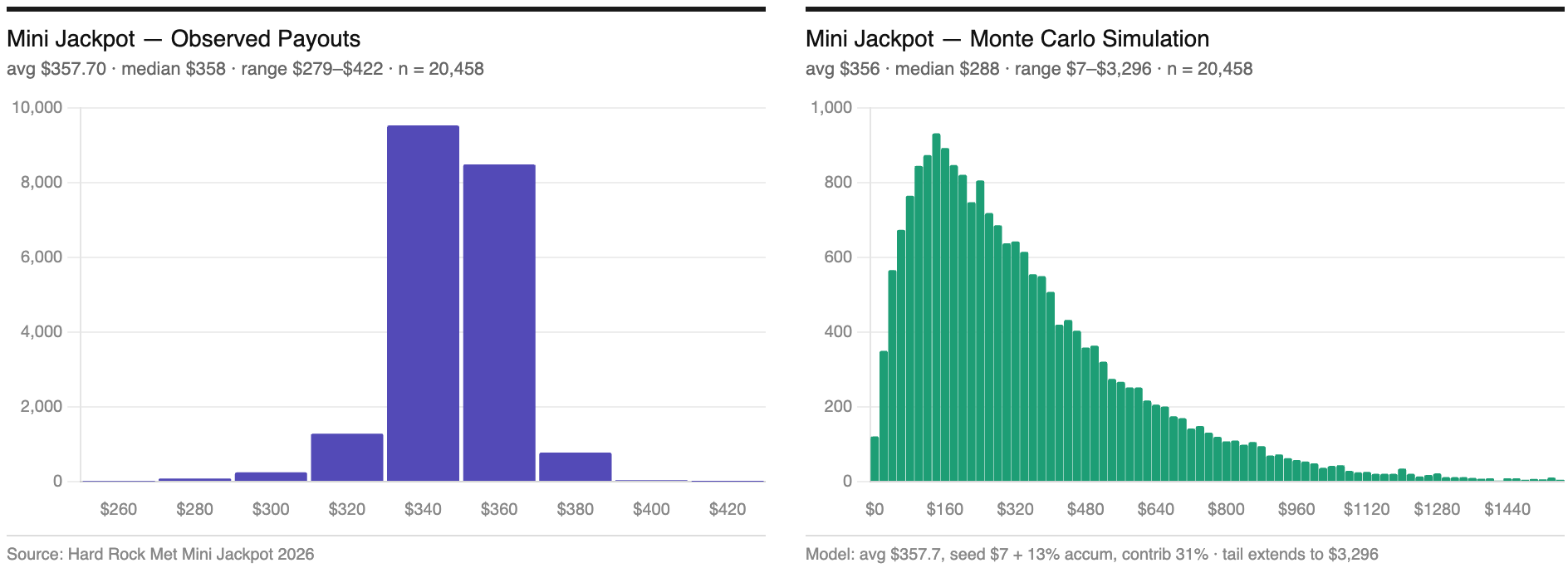
It should be exponential: a peak at the lower bound, then a smooth decline. Instead, it’s a bell, packed into the middle of the range.
It should be widely spread: the simulation ranges from $7 to $3,296. Instead, there’s a narrow corridor of $278.86 to $421.62.
There should be a long tail: rare, but large payouts. Instead, there’s a hard ceiling. Not once across 20,458 hits did the payout move outside that corridor.
There should be a gap between the mean and the median: a long tail of rare, large payouts pulls the mean up while the median stays lower (in the simulation: mean $356, median $288). Instead, Hard Rock Bet’s mean and median are nearly identical: $357.70 and $358.48. That’s the signature of a ceiling, not an open tail. If large payouts were possible even occasionally, they’d pull the mean upward the way they do in the simulation. Here, they don’t.
And the most telling part: the frequency of wins should rise and fall gradually. Instead, there’s a sharp break at two specific points. Below $340, wins are eight times rarer. Above $380, they’re ten times rarer.
A break that sharp, at two specific points, is statistically impossible for a distribution that rises and falls naturally. It looks much more like a hard condition built into the jackpot’s own payout logic, as if the odds of winning were sharply suppressed below a certain amount and sharply boosted above it. That’s how “must-hit-by” jackpots typically work, where the odds of a payout deliberately climb as the amount nears a target threshold. Nothing like that is mentioned anywhere in Hard Rock Bet’s rules for the Mini jackpot.
This isn't just a theoretical model on paper. The same shape shows up in real, non-simulated data too. Here's an actual jackpot from the provider Red Tiger, where every bet has the same odds of winning, with data collected at a different casino: 2,056 real hits.
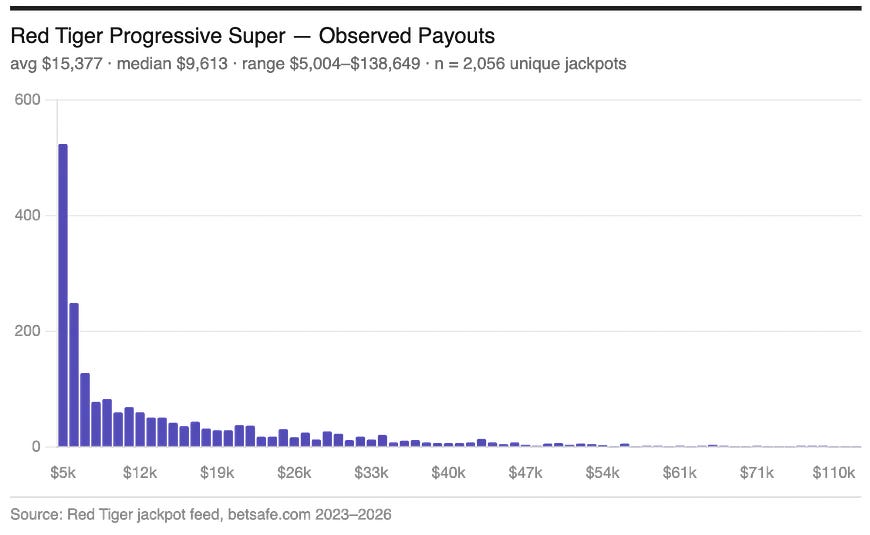
The shape closely matches the simulation: a peak near the lower bound, a smooth decline, and a long, rare tail stretching to $138,649. And the same gap between mean and median seen in the simulation: an average of $15,377 against a median of $9,613, with rare, large payouts pulling the mean upward while the median stays far lower. This is what an honest, fixed-probability jackpot actually looks like — not a hypothetical, but a real one, drawn from real payout records.
Hard Rock Bet’s Mini jackpot matches none of it. The conclusion is hard to avoid: it is statistically impossible for the jackpot to comply with the rules advertised on the website.
The Rules Say One Thing, the Numbers Say Another
Hard Rock Bet's rules claim that the jackpot is random and that every bet has an equal chance of winning. But 95% of all payouts fall inside a $326–$383 corridor, and wins drop sharply below $340. A bet placed well below that point had, in practice, far worse odds than the rules describe, no matter how many times it was repeated.
So the jackpots are random only in the sense that the results don’t depend on past values. The distribution of values isn’t random. It’s shaped by something specific.
That’s not the same as deception. A controlled algorithm isn’t automatically a euphemism for it; must-hit-by jackpots are controlled too, and they’re advertised as such. The problem here is narrower: the pattern in the data doesn’t match the pattern in the rules.
Besides that, there’s another strange thing about this jackpot.
The rules state: “If there are insufficient funds in the Reserve to meet the reset value, Hard Rock Bet will fund the difference to ensure each jackpot reset value is met.” The same rules also state that the jackpot starts at $7.
So according to the rules, the starting value should be $7 even if there isn’t enough money in the reserve, but what happens if there’s a surplus of money isn’t specified anywhere.
Usually in such cases all that money also rolls into the fund for the next jackpot (standard practice for many jackpots). The rules also specify how each bet is split: 31% of the jackpot contribution goes into the current Mini pool, and 13% goes into the mini reserve.
If you apply these official percentages to the actual average win of $357.70, the starting value should come out at around $357.70 / 31% × 13% = $150. However, according to a subscriber’s observations, the actual starting value hovered around $90.
There's no must-hit-by language anywhere in the Mini/Minor/Major/Mega rules, either — instead, they promise an equal chance on every bet. And in the general educational section about progressive jackpots on the same site it says: “No strategy or skill can influence when they hit.” If the data I’m working through in this piece is correct, for the Mini jackpot that is, to put it mildly, not quite the case.
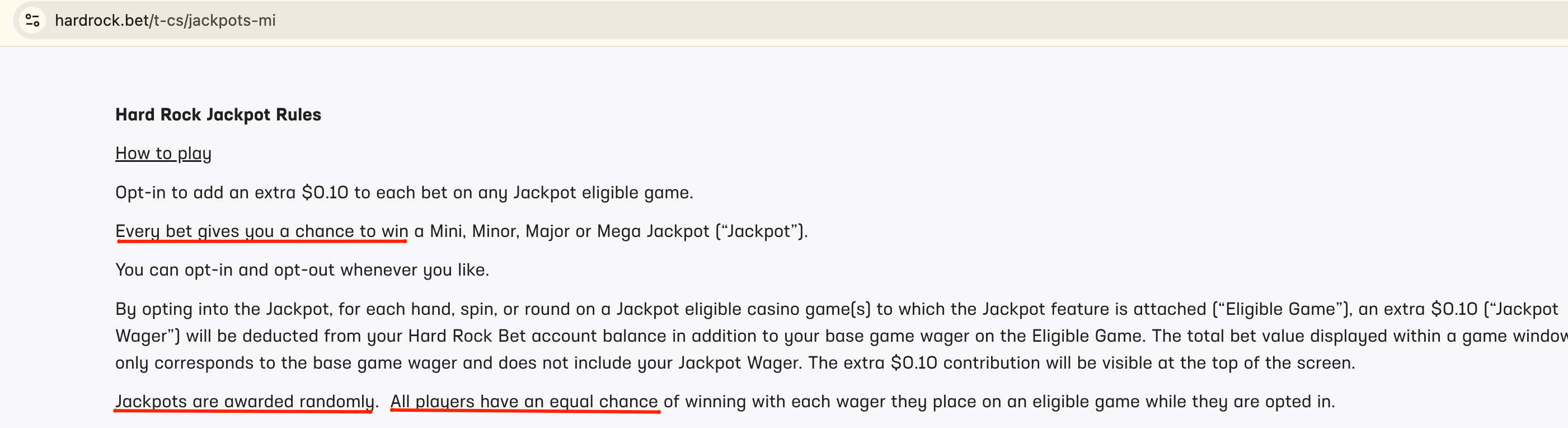
The player pays an extra 10 cents on top of every bet specifically to take part in the jackpot. If bets below $337 are structurally unable to win, then the RTP (return to player) in that range is apparently zero, the player is paying for a chance that, if the data holds up, simply doesn’t exist in that zone.
Win the Jackpot, Get Banned
The irony of this story is that its hero isn’t a victim of the casino in the usual sense, but a player who beat the system using its own rules. He didn’t break anything, didn’t register fake accounts, and was punished for it anyway:
“I stopped because my account, my wife’s account, and later on, the accounts of dozens of other people, all got suspended. Hard Rock accuses us of no wrongdoing but has locked our funds/accounts and now ghosts us completely. One person who won a Mega Jackpot back in March has still not been paid for it despite doing nothing wrong.”
Support's reply was the standard one: the account had been suspended "for your protection," pending a review that would restrict access in the meantime.
By the player's account, this pattern repeats: players are now getting suspended within 48 hours of starting to play the Mini jackpot strategically. Accounts aren't closed outright. They're suspended indefinitely. As he put it, "they would have to pay out your final balance to close your accounts, and they don't want to do that."
The casino bans players who win by playing the jackpot, doesn’t bring any accusations against them, and, most surprisingly, doesn’t remove a jackpot that doesn’t match what’s stated in the rules, doesn’t change the rules, and doesn’t publish any statements.
Hard Rock Bet, it seems, still hasn’t figured out what’s wrong with its own jackpots, and simply bans the people who win by playing them.
The player filed a complaint with the Michigan Gaming Control Board. On May 6, 2026, a response arrived whose essence can be boiled down to one sentence: the complaint review process doesn’t exist to return money to the player or to inform them of the review’s results.
“...its purpose is not to provide you with: (1) an administrative remedy to obtain money or any other form of legal or equitable relief from a licensee... or (2) information on the Board’s review of, and findings regarding, your... complaint... you should not expect to receive further correspondence or updates from the Board regarding this... complaint.”
In other words: the regulator can (in theory) penalize the casino as a licensee, but the player who filed the complaint will never be told about it, and it won’t get him his money back.
Conclusions
In my view, and I'm firmly convinced of this, mistakes happen anywhere people are involved.
I’ve made that argument before, with other examples, and I think it applies here too. I don’t believe Hard Rock Bet wrote one set of rules and deliberately built something else. It’s more likely that someone, somewhere in the rules-writing or jackpot-configuration process, made a mistake — and that “someone” has a first and last name, a specific person or team behind specific decisions.
Is a mistake like this worth regulatory attention? I think so, because as it stands, the gap between the stated rules and the actual odds misleads players. When you buy a lottery ticket, you expect every ticket to carry the same odds — not that some tickets, by design, never had a chance to begin with because they were bought at the “wrong” moment, while others never had a chance to lose.
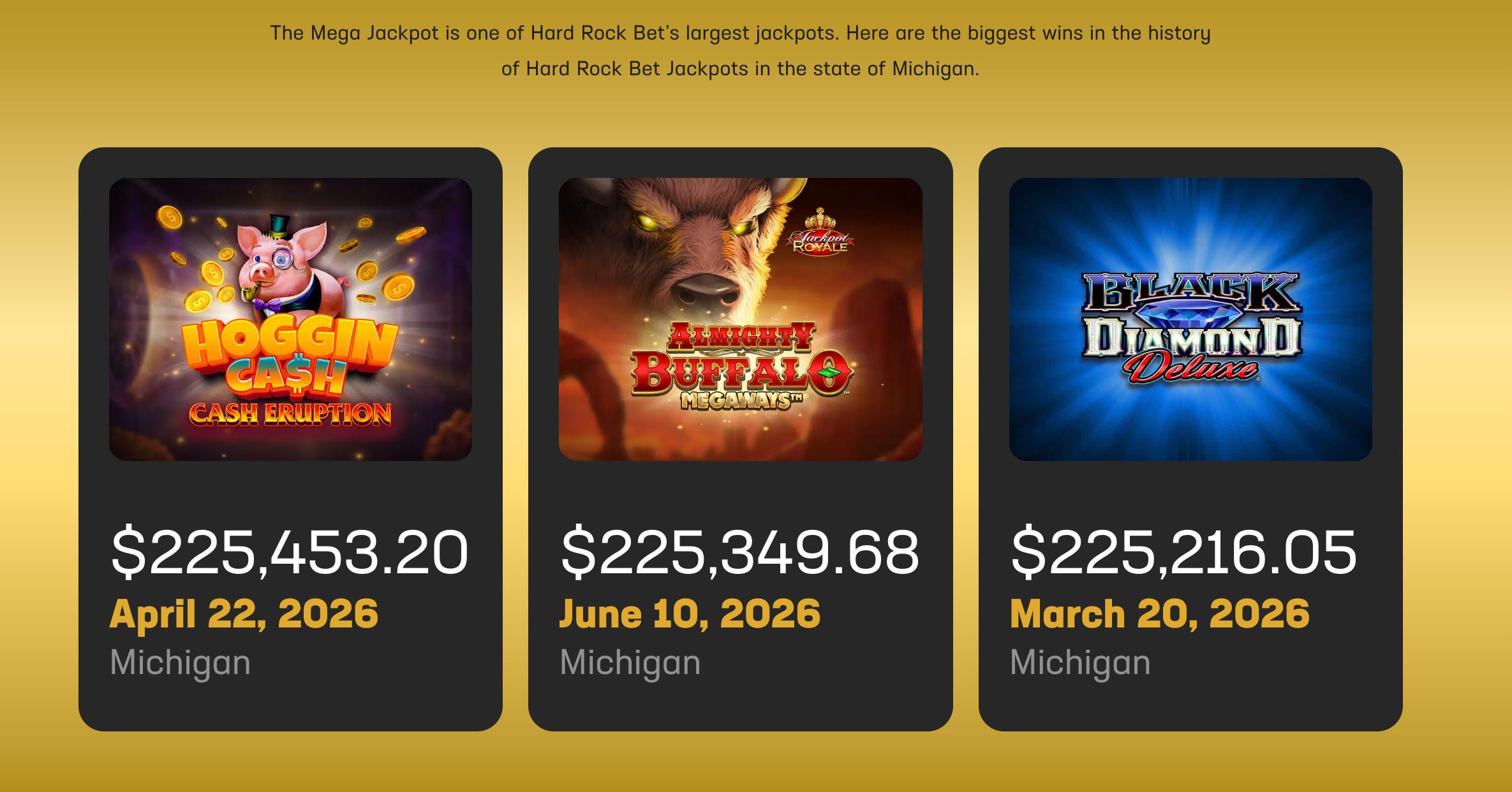
In a private message, the player told me a Mega jackpot in Michigan was about to go off, climbing toward six figures. He was right. It hit shortly after, at $225,413.77. Hard Rock Bet's own website backs that up.
Whatever turns out to be happening here, in a genuinely random jackpot, nobody should know in advance when it’s about to go off.
The most common practice ties contribution to turnover. For example, €500,000 in turnover equals 5,000 bets of €100, or 50,000 bets of €10, and so on. This logic is used in jackpots like NetEnt's Red Tiger and Yggdrasil.
My personal unlucky streak was about 300 consecutive bets without hitting the same number while betting $600, and about 200 bets while betting $1,000. There were a few times when the same number came up twice in a row at the $1,000 bet level, and many times three in a row at bets ranging from $1 to $15.
Gambler's razor: Never attribute to attribute to stupidity that which is adequately explained by insiders trying to gain an edge
Incredibly well written. It's amazing that this is not something from the past, but is still ongoing in Michigan and New Jersey (albeit with different numbers in NJ). Incredibly, Hard Rock has been contacted directly and told all of this information, and they refuse to remove the jackpot feature or change how it operates. Is their primary intent to collect the entry fees from people playing with no chance of winning, then also refuse to pay winners? It currently seems so.