

Last November, there was an unusual high roller tournament with a $5M prize pool, winner takes half. The tournament ran for a month, and the winning criterion was simple: whoever wagered the most won.
But the wager was calculated in a clever way. Slots with 4% house edge gave twice as many points as slots with 2% house edge. The math worked like this: for every dollar lost, you got 50 points. Not actual dollars lost, but expected dollars lost. In other words, it wasn’t about who wagered the most—it was about who was willing to lose the most.
I don’t usually look at these tournaments as +EV opportunities. The competition is typically too fierce relative to the prize. Like first place spends $1M to win $100k. But this one had a ton of side tournaments.
Throughout the month, there were weekly tournaments with prize pools from $500k to $1M. Daily tournaments from $50k to $100k. Some days had hourly tournaments. You could rack up points that counted toward four tournaments simultaneously: hourly, daily, weekly, and monthly. Meaning you play once, and your points count across all four tournaments at the same time.

There was too much money in play for this not to be profitable. This was the third tournament in the series; the previous two had $1M prize pools each. Winning on the down-low while nobody knew about it was no longer possible. But as you can tell from the title, it was profitable to play.
Why This Was Profitable
The sum of all first-place prizes was $4,625,000. Even if you lost $3M to win $2.5M, you’d still be up thanks to the side prizes. I was confident the winner would finish in profit, but I didn’t play myself.
Risking that kind of money at a new casino is a questionable idea. There’s always the risk of payout issues. Plus I was worried about shill players or several big high rollers destroying all expectations.
But you don’t have to win the tournament to finish in profit. Even though first place gets 50% of the prize pool in all tournaments, there were still winning strategies with minimal risk.
Before we look at optimal strategies, let’s start with how it all ended.
Tournament Results
The winner, signature, took first place and netted +$490k. He skipped some days, didn’t always claim first places, and sometimes won by too large a margin. If he’d spent more efficiently, he could have made another +$195k.
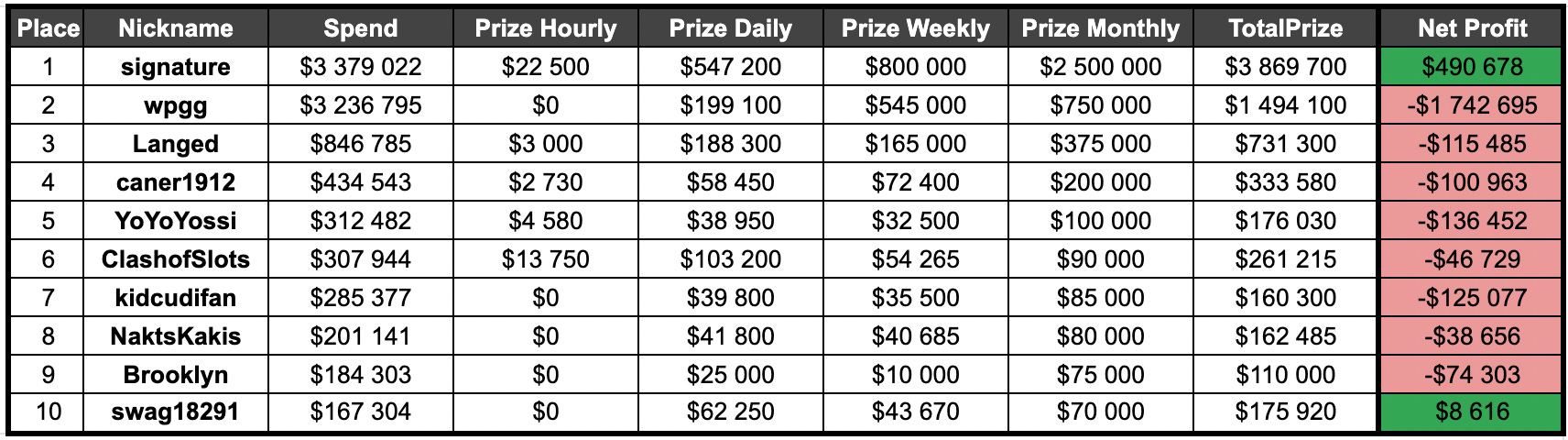
The second-place player lost $1.7M. Of that, $600k was spent on the last day trying to overtake the leader.
Out of all tournament participants, only two finished in profit: first and tenth place. Everyone else lost. In total, the tournament earned the organizers $3.4M.
The Dollar Auction on the Final Day
On the last day of the tournament, a classic dollar auction played out. Player wpgg, who was in second, spent $600k trying to overtake the leader. Winner signature responded by also spending $600k to defend first place.
In the end, nothing changed. Each player lost an extra $600k!
t might seem like this was rational for wpgg. Spending $600k for a shot at an additional $1.75M (the difference between first and second place) sounds like a deal. But it's a trap.
