

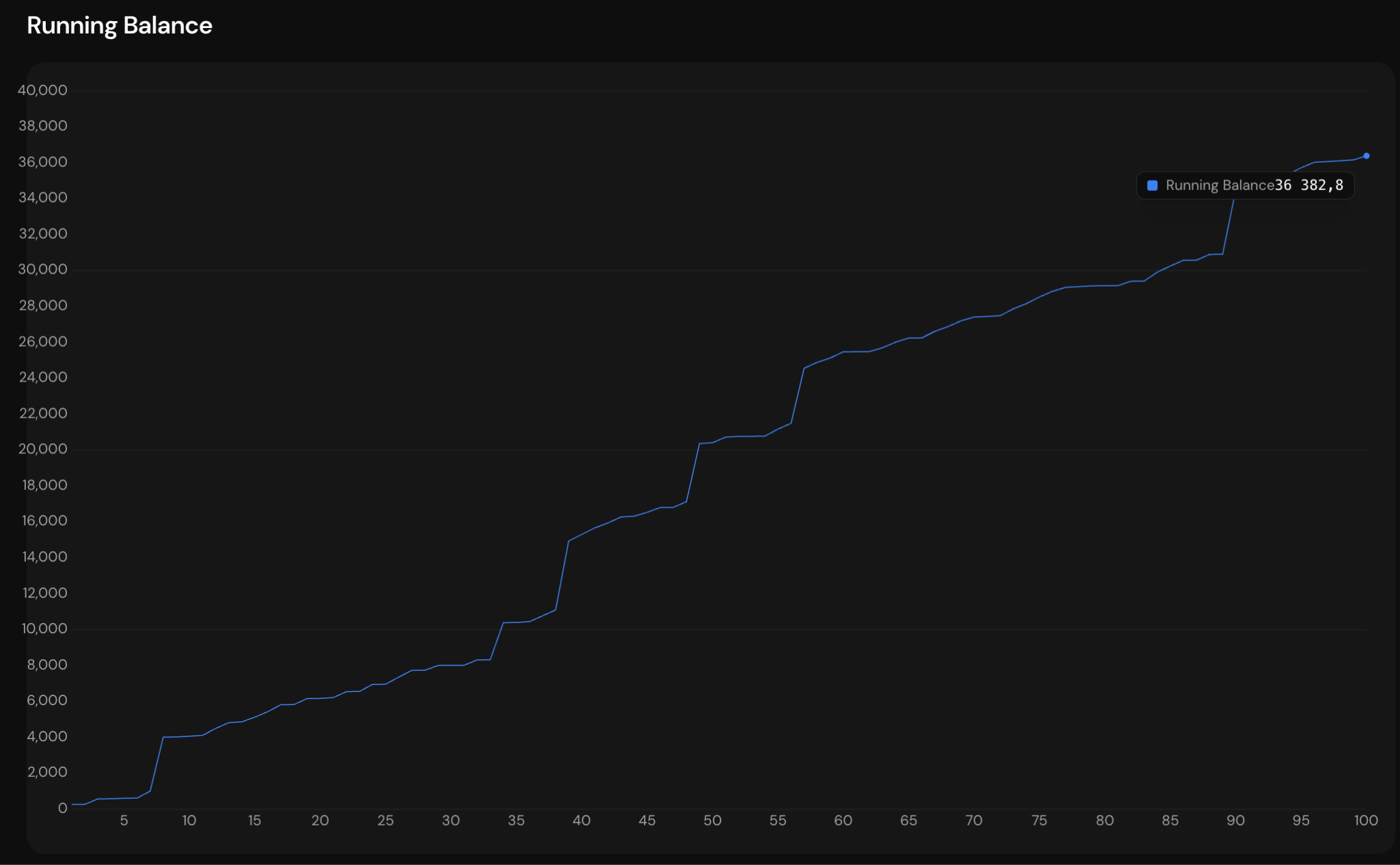
On November 19, I placed 100 bets of 10 cents on Dead by Dusk at Stake.com and lost $5.03. The round check showed that the game should have paid out $3,648.28. A week earlier, on November 13, 20 bets on the same game were worth $997.92 according to the game’s published payout table, and the casino paid $0.18.
Provably fair is an alternative to the familiar random number generator in traditional online slots, positioned as the most transparent and fair mechanism for players.
On April 25, 2026, Stake co-founder Ed Craven wrote on X that provably fair was already live in more than 1,200 Stake Engine games on Stake.com and Stake.us, and promised: “No more black box RNG or hidden mechanics.” There are far more games now: the Engine fairness catalogue lists 8,939 of them (as of November 23, 2026), most of them slots, and 791 were added in the single week from November 16 to 23.
On September 15, 2026, Stake Engine became simply Engine and opened up to other casinos, and some of them have already added its games to their sites1.
Traditional slots are made to a simple recipe. A studio draws and animates the game and also designs the math: how many reels there will be, which symbols go on them, what those symbols pay, how the bonus game is triggered, and so on. For the math to work properly, the game needs a random number generator (RNG). Large providers have their own, while smaller studios can release games through someone else’s server with an RNG that has already been tested. Before a game goes live in a regulated market, it is checked by an independent certified lab. GLI, eCOGRA, BMM and other specialist labs check that the RNG2 is truly random, that every spin is independent of the previous one, and that payouts match the stated house edge.
For the player, this means they can’t check anything on their own,3 but the RNG and the game’s house edge have been checked by an independent third party.
There are at least four parties: the game developer, the lab, the casino that uses what the first two produce4, and the regulator that sets the rules of this ecosystem. Sometimes there is a fifth party as well: an RNG provider for studios that don’t have their own.
Provably fair on Engine works differently
A studio draws a slot and describes its math the same way as with traditional slots. Then the differences begin. The game is run through Engine’s open-source Math SDK. It also makes millions of spins, but for a different purpose: every spin is recorded to build the outcome table, which Engine calls a lookup table: a list of every possible outcome and how likely it is.
A lab runs a regular slot millions of times to test the game. The Math SDK runs it millions of times to create the game. Each game mode has its own lookup table, which boils down to how likely the different payouts are. Which specific row of the table pays out is decided by the RNG, which works from the server seed, the client seed and the nonce (the bet number). The player can check that the RNG result is fair, but can’t check which table the payout comes from. That is something Engine is supposed to check.
The company that provides its engine to developers and reviews the games they build is Stake itself: the contracts with studios are signed by Medium Rare N.V., the company that operates Stake.com. Independent developers depend on Engine: a game has to be new, and it can’t be sold directly to another casino, only through Engine’s operators. Let’s take a closer look at how this system works.
Lookup tables
All the math of games built on Engine rests on lookup tables calculated in advance. Here is the simplest example of such a table, with five rows.
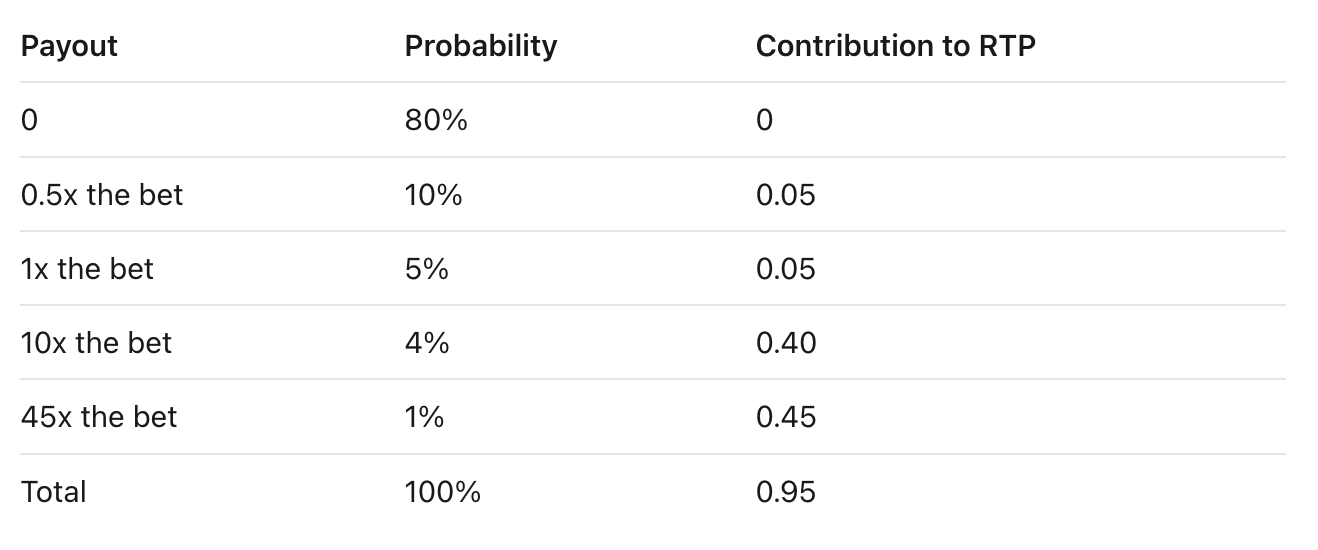
Return to player (RTP) is the sum of the payouts multiplied by their probabilities: 0 × 0.80 + 0.5 × 0.10 + 1 × 0.05 + 10 × 0.04 + 45 × 0.01 = 0.95. So the RTP is 95%, and the house edge is 5%. The chance of the maximum win is 1 in 100, and the chance of getting nothing is 4 in 5.
Real tables are much bigger. In the Engine catalogue, half of all modes have 27,000 rows or more, and the largest have 20 million. The Candy Dash base game, which I’ll use as an example, has 1,538,181 rows.
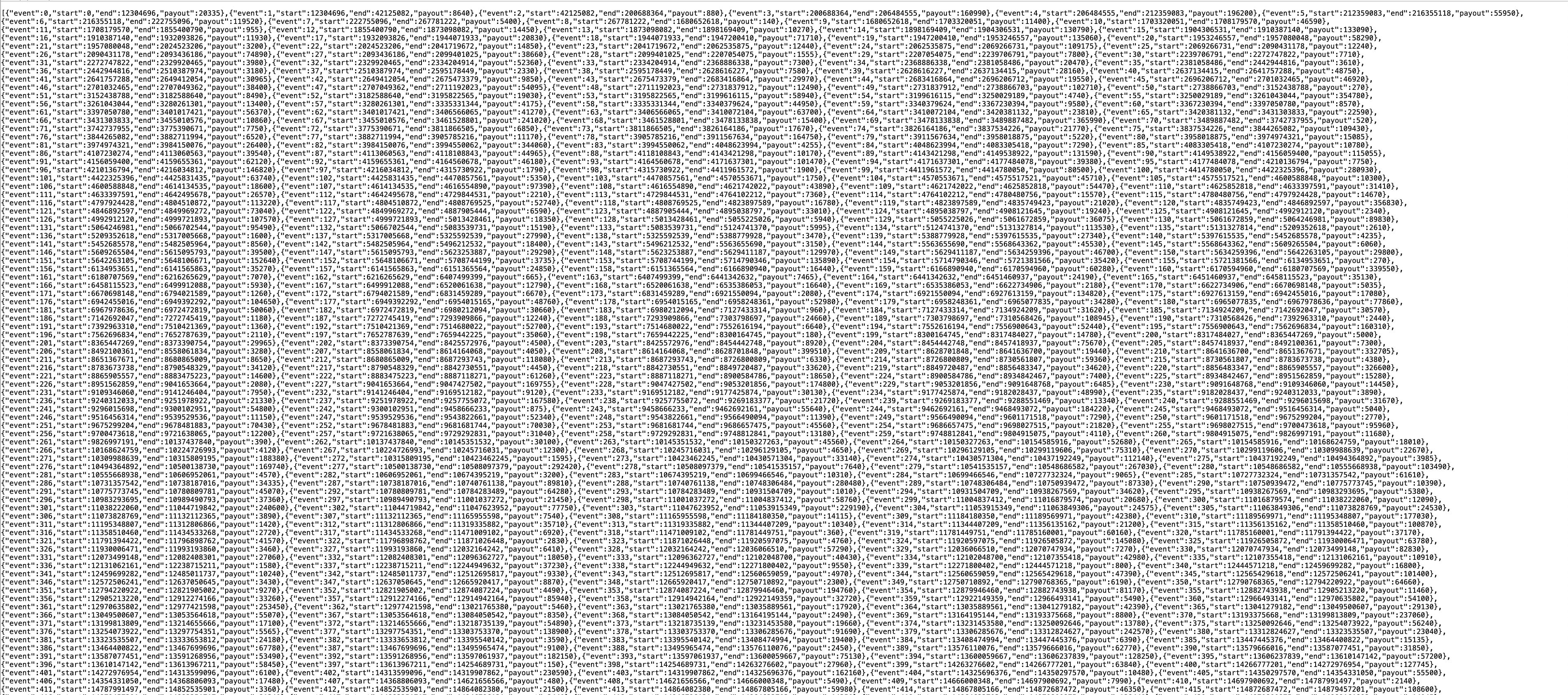
The table is quite simple. It is a set of rows that describe how much you get paid, how likely that is, and how many different ways a given win can look.
Let’s take an example from the Candy Dash base game (version 1): row 330030. Its payout field is 500990, which is the payout in cents on a 100-cent bet, so 5,009.9x the bet, the biggest win in the game. The row’s weight is the difference between end and start: 4,504,227,519,493 − 4,504,205,001,495 = 22,517,998. To get the probability, divide the weight by the sum of the weights of all rows, which you can see in the last row of the table.

The rows follow each other without gaps: the first starts at zero, and each next one starts where the previous one ended. So the end of the last row is the sum of the weights of the whole table: 4,509,936,362,360,000. The chance of landing on the row with the biggest win is its weight divided by the sum of the weights: 22,517,998 ÷ 4,509,936,362,360,000, or once in 200,281,409 spins.

There is only one such row in the table. Each row is one round played in advance, so a 5,009.9x win can land in only one way: exactly as it is recorded in this row. The table has 200 rows with wins from 5,000.05x to 5,009.9x, all with the same weight of 22,517,998. Together that is 200 × 22,517,998 = 4,503,599,600; divided by the sum of the weights, such a win lands once in 1,001,407 spins.
For context: the Candy Dash base game has 200,000 rows that pay zero, which means 200,000 different ways to win nothing.
Another feature of these tables is that any of these wins or losses can be replayed.
For example, the biggest win in Million X is 1,000,000x the bet. The table records it in 26 rows, that is, 26 rounds played in advance. I opened one of them, row 152494, in Engine’s public replay, without placing a bet and without an account. This replay can’t be told apart from the replay of a real-money bet.


Over its lifetime, the game has taken 70.4 million bets (Engine Insights data as of November 13). Even if all of them were in the base game, the chance that nobody has ever hit the million-times win is 7.8%.
The RNG
So how does the game decide which row to play back? Will you win nothing, or hit the max win? This is where provably fair comes in: a mechanism that replaces the familiar RNG. It determines the outcome of every bet before you even start playing. Here’s how it works.
You have your own seed, a string of characters you can change. The casino has its own server seed, which is hidden from you for now: you only see its fingerprint, a hash. The two seeds, client and server, work as a pair. A standard cryptographic function, HMAC-SHA256, built on the SHA-256 hashing standard, mixes them with the bet number. For each bet this produces a different value, and that value picks a row of the table: it falls into one row’s range, from start to end. The bigger a row’s weight, the wider its range and the more often it comes up. This function plays the role of a random number generator. The randomness comes from the seeds; the function only turns them and the bet number into that value. That’s why, unlike the RNG in a regular slot, anyone can recalculate its result.
The casino sees your seed right away. When you change your seed, the casino reveals its old server seed. You can then check it against the fingerprint: if the casino had swapped its seed, the fingerprint wouldn’t match, because a different seed has a different hash. And you can recalculate every bet, down to the row it landed on.
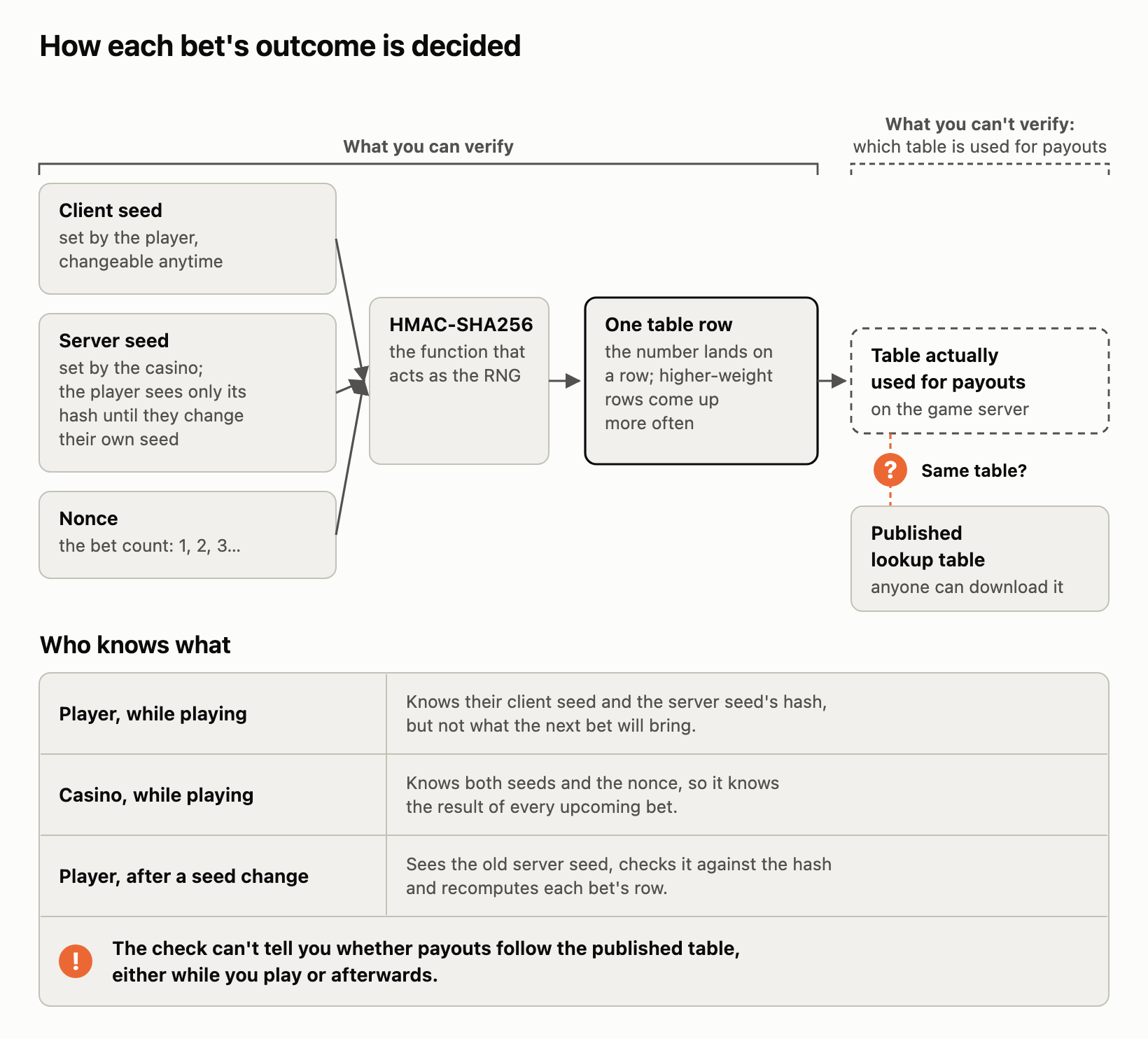
From there, the game plays back exactly the scenarios that were recorded when the tables were built. The number of rows in a table is the number of possible scenarios5. Nothing else can happen.
Provably fair has one more catch, long known in cryptography6. The casino knows the server seed, your seed and the bet number, so it knows the outcome of each of your next bets before you press the button. That means the casino could, in theory, refuse to play a bet that would cost it.
It can’t change which row comes up. But if it saw that your next bet was going to hit the max win, it could refuse that particular bet. The only way you’d find out is by noticing that the bet numbers skip: if a bet was cancelled and the number moved on anyway, the check would show a missing number, like 25, 26, 28.
This isn’t a made-up example. In 2014, players accused DiceBitco.in of exactly this: by their account, the site was skipping winning rolls, and the missing numbers gave it away. If the casino itself changes the seeds right before a bet, that can be spotted too, but only if you’re watching: after the change, the casino reveals the old server seed, and it shows what the next bet on the old pair would have paid.
This is where provably fair ends. Up to this point, you can check everything yourself: the seeds and which row came up. You’ll see what you were paid in your bet history, of course. But the check doesn’t show which table the game used to work out that payout7.
Oversight
As shown above, the choice of row can’t be tampered with; the most a casino could do is refuse certain bets. But the payout also depends on the payout table, and provably fair doesn’t check the table at all. That’s a weakness of the method as a whole. In 500 Casino’s own game Towers, for example, the provably fair checks passed while the game paid less than advertised: the casino promised a 5% house edge, but in practice it reached as much as 40.13%. In Winna’s Plinko, from December 17, 2025, to March 2026, the game drew its outcomes from a modified probability table that raised the house edge from the advertised 1% to 2%. Every bet passed verification, but the odds weren’t the ones advertised.
The payout also depends on the payout table, and provably fair doesn’t check that table at all.
Engine’s documentation says a game’s math can’t be changed after release, except to fix a confirmed bug. A player won’t know a table has changed unless they make a point of downloading a table with millions of rows every day and comparing it with the previous one. There’s no independent body that checks this, and no separate provably fair for the payout table either: nothing that would let you confirm the table hasn’t changed since the game launched, or that it’s the table the game actually uses to pay out wins.
Regulated markets have solved this, but only the regulator gets to see the solution. An independent lab takes a fingerprint (a hash) of the certified version of the game, including its paytable. The casino’s system then automatically checks that the same version is running: in New Jersey, for example, at least once a day, and if the check fails, the game is taken offline and the regulator is notified. Engine’s tables are public, but there’s no published fingerprint and no one to check it. In theory, Engine could publish a fingerprint for every version of a table, with dates, and show it on every bet. Then players could check for themselves what the regulator checks in regulated markets. And Engine already computes that fingerprint: its open-source tool for game developers records a SHA-256 hash of every table. So the fingerprint exists. It’s just not for you.
I checked how this works on Engine. The tables are public, and anyone can download them. According to Engine Insights, as of November 16, 2026, about 14 billion bets worth $31 billion have been placed on Engine games. I took the 1,500 most popular Engine games by turnover (from the November 13 ranking). Tables are published for 1,425 of them8. Those games account for about 80% of the turnover and have 32,660 tables between them. A single game can have several: one for the base game, a separate one for each bonus buy, and the same goes for boosters.
The first thing I did was add up the probabilities multiplied by the payouts to get the RTP, and compare it with the advertised one. For 49 modes in 13 games, it didn’t add up. In the Dead by Dusk base game, for example, the table puts the return at 39,487% instead of the advertised 96.48%, and in the Wolf Den base game it reaches 72,228% against an advertised 96%.
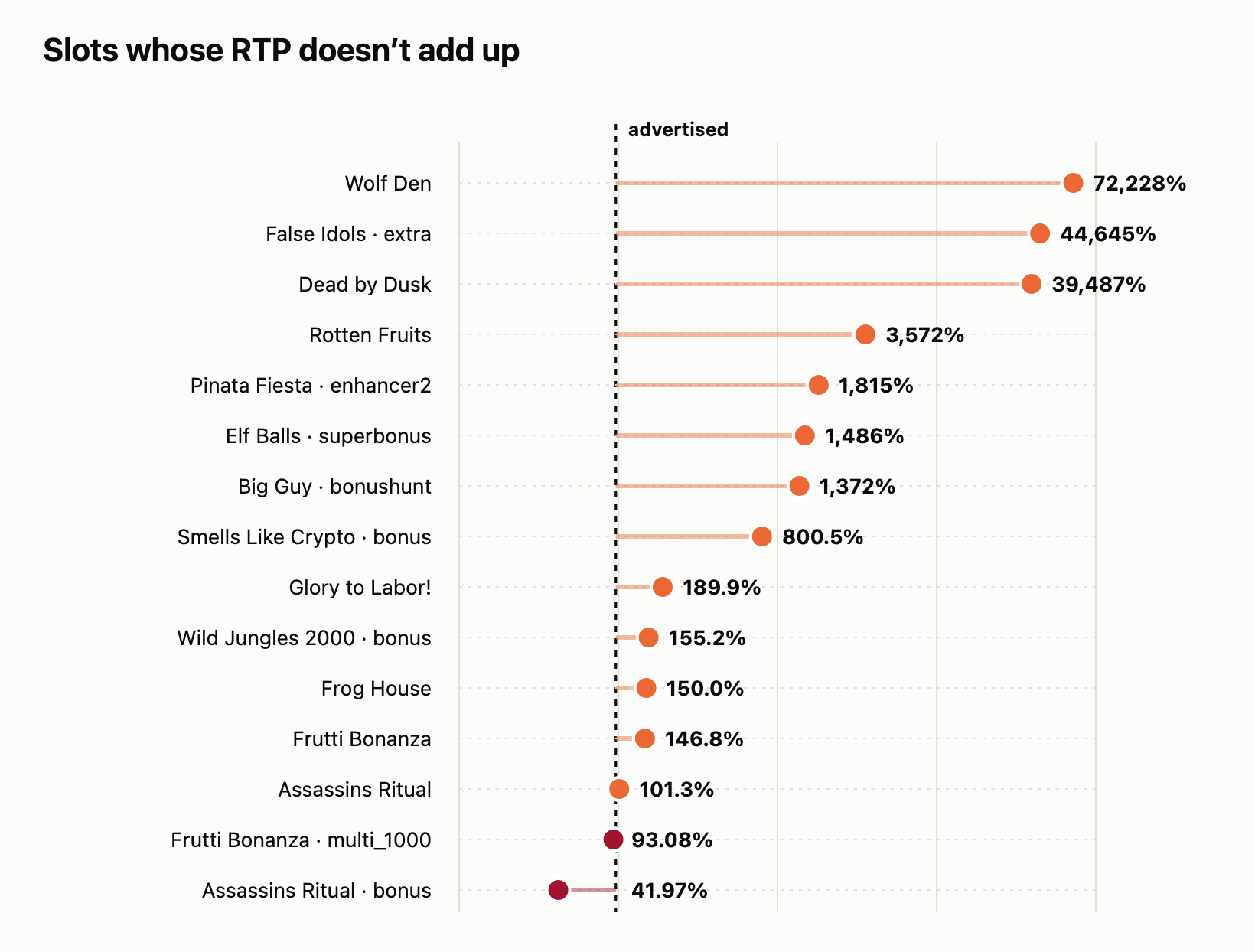
It sounds unbelievable, but anyone can check it. Just go to Engine’s verification page and run 10,000 rounds, with no money and no account. To rule out variance, I ran 1,000,000 rounds through Engine’s verification server for each of these 49 modes: 100 different seed pairs, 10,000 rounds each. The result held: every payout matched the published tables.
Could a game that’s supposed to keep 3.52% really be paying out tens of thousands of percent without anyone noticing?
The real-money test
As an advantage player, I found the prospect of playing Dead by Dusk at an RTP of around 40,000% tempting. Common sense said a mistake that huge would probably have been fixed quickly, but I decided to see it through and play for real money.
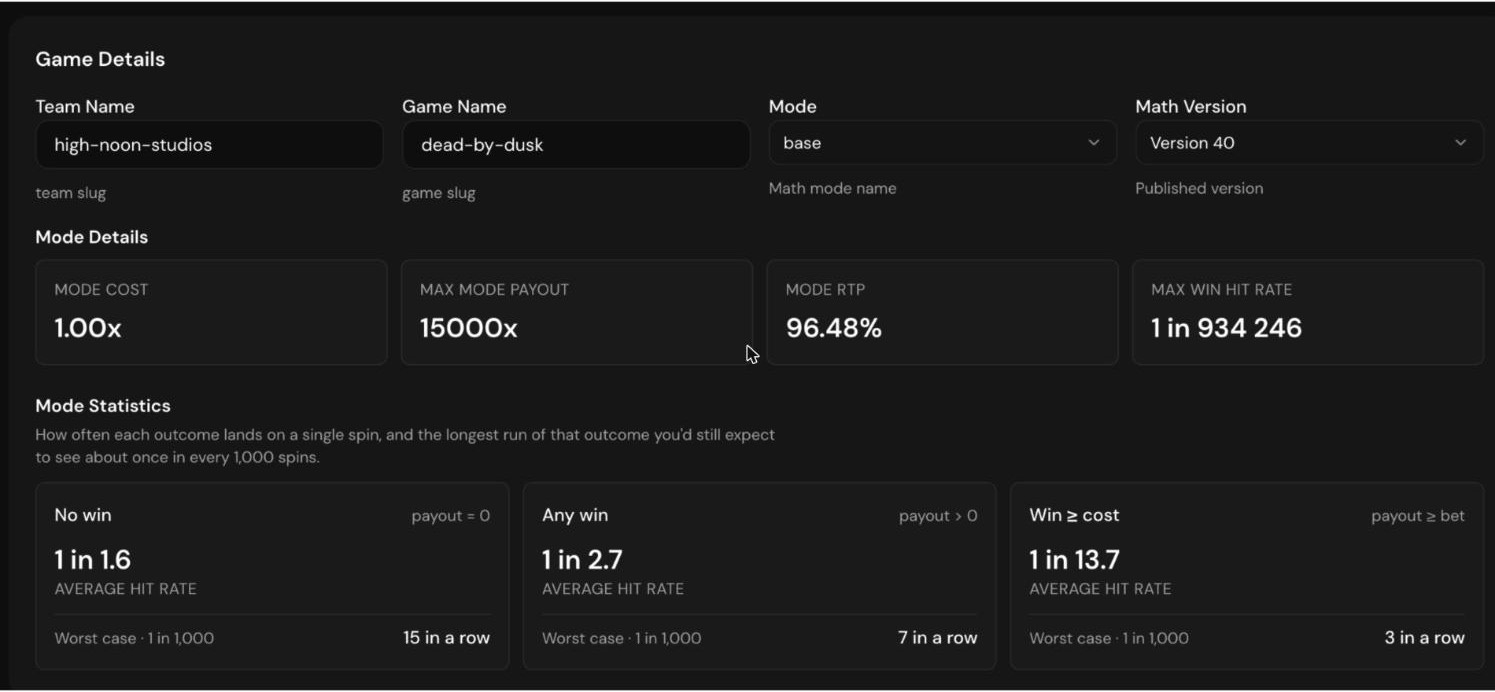
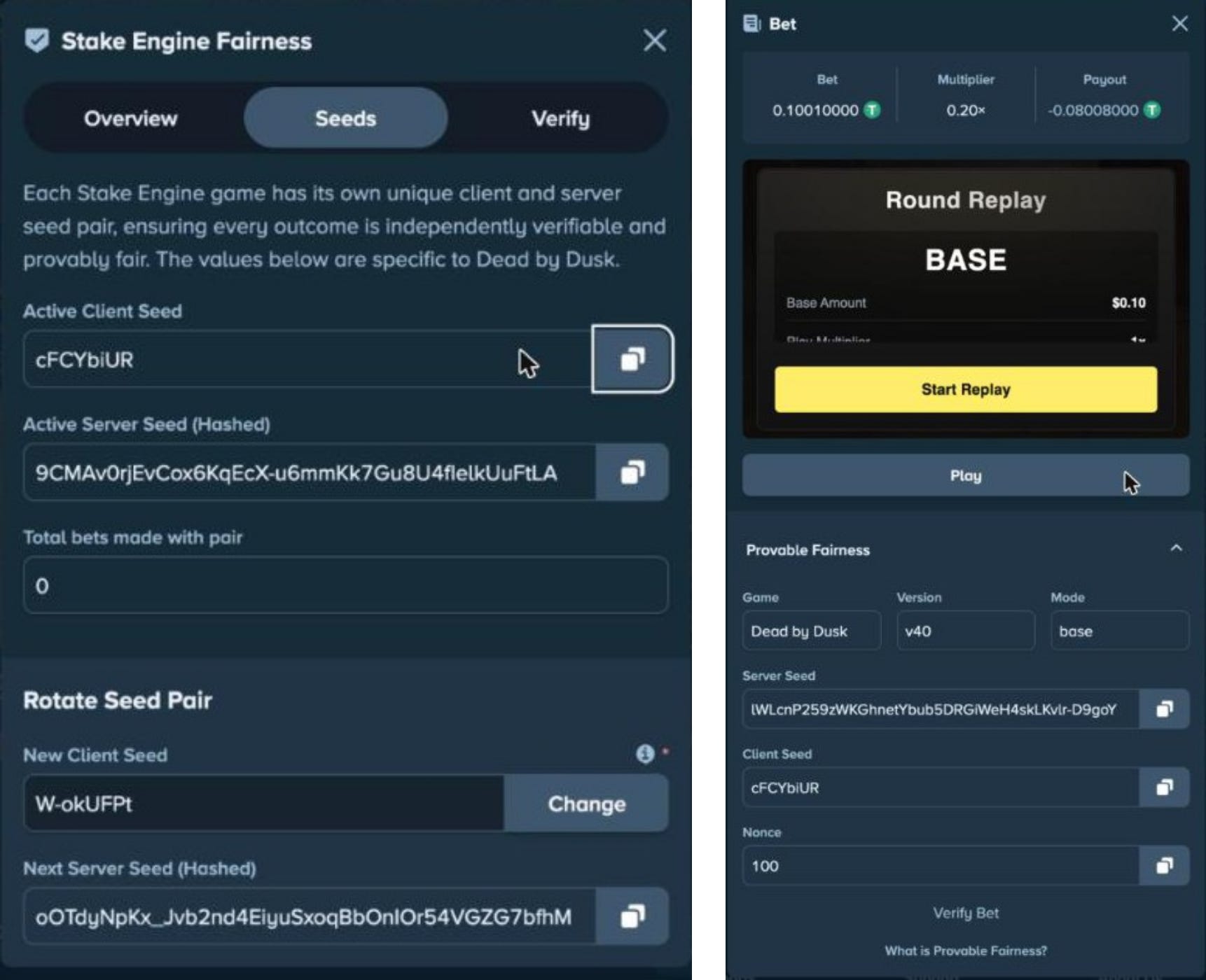
I placed 100 bets of 10 cents on one seed pair, then changed the pair, and the casino revealed its server seed. Its fingerprint matched the one shown before I played, so every bet can be recalculated against the payout table.
100 spins at 10 cents for real money returned $4.97 instead of the $3,648.28 the table says they should have.
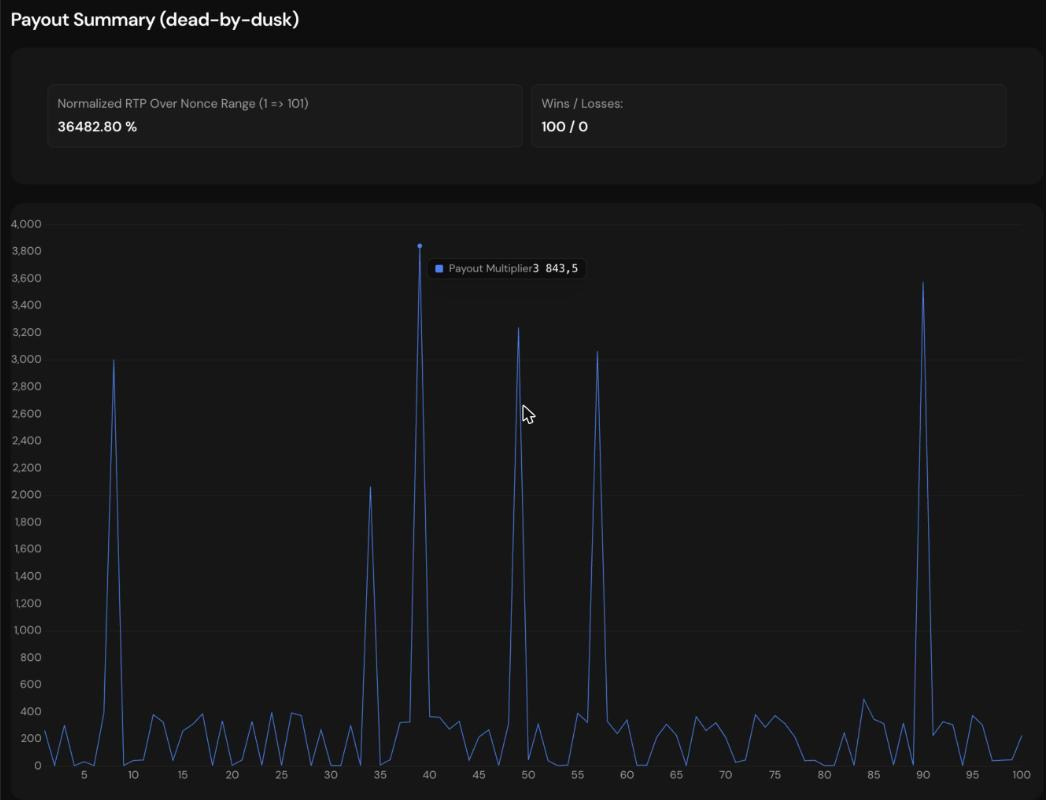
Not one of the 100 bets matched the published table. 65 rounds paid nothing, although by the table each was worth between 5.6x and 3,843.5x the bet, and the table pays zero on only 0.4% of spins.
There is one more check: the Verify tab in the “Stake Engine Fairness” window inside the game. I checked my bets there. Unlike Engine’s verification page, Verify showed that I had been paid correctly: for the 100th bet, for example, 0.2x the bet instead of the table’s 228.2x.
So the real-money game pays by some other table, one that differs from the published one and isn’t publicly available. The game came out on February 4, 2026, but there is no way to tell from public data how long the wrong table has been on the site.
I also checked a few other games with suspicious tables. In Smells Like Crypto (551% by the table against an advertised 97%), only the empty rounds matched: not a single win matched its row.
Then there’s Frutti Bonanza, where the bonus-buy tables go the other way: their RTP is lower than the slot’s rules state.
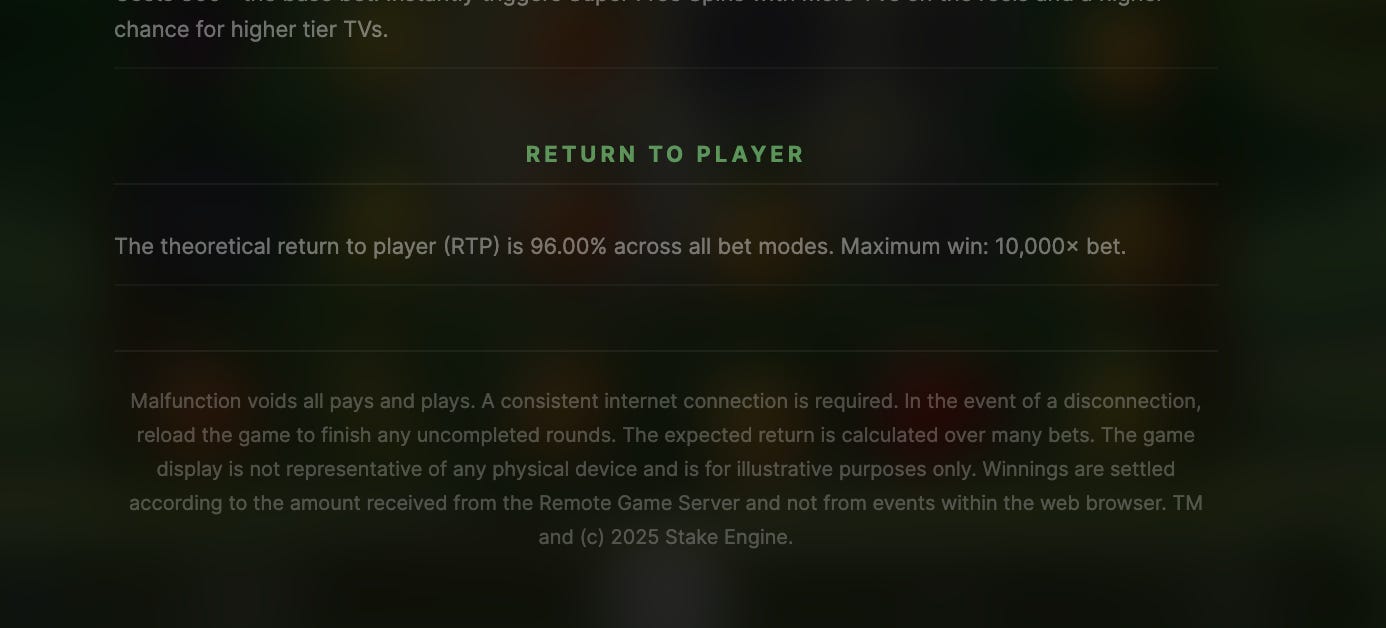
Frutti Bonanza’s rules promise “96.00% across all bet modes,” but the tables for five of the six buys give 93.08–95.14%. I bought several bonuses: every one paid exactly what its table row says, but less than the buy price. In the base game (146.84% by the table), 24 of 25 rounds matched: all the empty ones and every win below the stake, from 0.25x to 0.75x. The only one that didn’t match was the single win above the stake: 1.5x by the table, 0.7x paid.
It follows that if the published table differs from the real one in just a few rows, the ones responsible for big wins, it is extremely hard to detect.
Imagine a game with a 96% RTP and a 4% house edge. It has a 40,000x max win that lands once in a million spins and accounts for 4 of those 96 points. Without that max win, the RTP drops to 92% and the house edge doubles to 8%.
Now imagine two tables that differ only in that max win. You can play hundreds, even thousands, of spins and see the wins match the table. But to be sure the game pays by the table with the max win, you would have to see that max win happen, and even over a million spins the chance of seeing it is 63.2%.
There is no quick way to know which table a game pays by! As with traditional slots, you have to trust that someone checked it for you. Except there, independent certified labs do it, and here it’s Engine, a platform owned by Stake. Stake checks itself, under the banner of provably fair!
Engine’s reviewers approve the game, and its server holds the table and calculates the payout. Engine says that because every outcome is known in advance, reviewers “can verify the math exactly.” Whether they check the table against the advertised RTP, and whether the game actually pays by it, is an open question.
When you press the button, you don’t know whether the game is paying by the table that was published or by some other one.
All 13 games with mismatched tables are already live. Glory to Labor!, released on September 12, 2025, has only one math version, v1. According to Engine, math can’t be changed after release except to fix a confirmed bug. So the table with a 189.90% return against an advertised 96.5% has been published for more than a year.
How can a player check this? They can’t. When you press the button, you don’t know whether the game is paying by the table that was published or by some other one.
Some games can’t be checked at all. 59 of the 1,500 most popular games, accounting for 16% of all Engine turnover, are missing from the public verification catalogue: Drac’s Stacks (No. 4 by turnover, $621.5 million) and Hexappeal (No. 5, $609.5 million), for example. Another 14 games have a base-game table that won’t open, and for two of them only part of the table is there. That’s 73 games and 16.5% of turnover in total. These games have no tables, or tables that won’t open, so there is nothing to check; you can only trust that Engine checked them. Probably fair?
I asked Engine, Stake.com and the studios whose contact details I could find for comment. Only Stake.com’s support team replied. First they told me it was down to volatility and luck: “it is entirely a matter of luck.” Then they wrote that the advertised RTP is the return over a very large number of rounds, that 100 rounds is far too few, and sent me a link to their article on RTP. When I pointed out that a table’s return isn’t the result of a hundred rounds but an exact sum over all of its rows, asked why the tables don’t add up, who checks them and how a player can find out which table a game pays by, and asked them to pass my request on to Engine, support replied with boilerplate.
Conclusion
In a regular slot, every spin comes from a random number generator, which in regulated markets is tested by an independent lab. The lab also tests the return of the slot that runs on that generator. Players can’t check anything themselves and have to trust the lab and the regulator. The distribution of wins and how often big wins and max wins land are, as a rule, not disclosed.
On Engine, the randomness comes from the player’s seed, the casino’s seed and the bet number. You can check that the rows come up fairly. But you can’t be sure which table your payout is calculated from, or what house edge that table has. That is Engine’s job, which means Stake’s: the fairness of games on Engine is checked by Stake itself. And Engine already computes a fingerprint of every table. For players to check the tables themselves, that fingerprint needs to be published with dates and shown on every bet.
Unlike with traditional slots, the published tables let you calculate the RTP, the distribution of wins, and how often big wins and max wins land. Provided, of course, the game actually uses them…
For example, Roobet, Gamdom, Rainbet, 500 Casino, YEET and Thrill.
Strictly speaking, the generator in an online slot can be software-based, that is, pseudorandom: it produces numbers using a formula. But the standards require it to be cryptographically strong, so that the next number can’t be predicted, and to an observer its output is statistically indistinguishable from truly random numbers. More on this in this piece.
Unless you take on the role of the independent lab yourself and collect several million spins in the demo game to figure out what’s what, which is, among other things, what I do.
A studio and a casino are sometimes part of the same group: for example, Greentube, a studio in the Novomatic group, runs the Admiral online casino itself, and Kindred, the owner of Unibet, bought the studio Relax Gaming in 2021. But the game is always checked by a third party, not by those who made it or profit from it.
Some tables also contain rows with zero weight, which can never come up. This is common: 397 of the 1,425 Engine games I checked have such rows in their base game. In Dragon Gems, for example, 1,242,108 of its 2,500,000 rows have zero weight.
A study called Remote Electronic Gambling pointed out that in schemes like this, one side learns the result before the other and can simply walk away before the game is over.
That a fair random number alone isn’t enough was clear almost 30 years ago. The same study notes that this kind of scheme doesn’t cover the rules of the game, and assumes that payout disputes are settled by an independent third party.
The other 75 places in the ranking: 59 games aren’t in Engine’s verification catalogue at all, including Drac’s Stacks, Hexappeal and Roosters Return from the top ten. Another 14 games are in the catalogue, but their tables don’t load, and the check on Engine’s page returns an error. Why these games have no tables, and who checks them, I couldn’t find out. Places 791 and 1,363 are missing from the ranking: there are no games under those numbers.
I find this quote from the article rather concerning:
"You have your own seed, a string of characters you can change. The casino has its own server seed, which is hidden from you for now: you only see its fingerprint, a hash. The two seeds, client and server, work as a pair. A standard cryptographic function, HMAC-SHA256, built on the SHA-256 hashing standard, mixes them with the bet number. For each bet this produces a different value, and that value picks a row of the table: it falls into one row’s range, from start to end. The bigger a row’s weight, the wider its range and the more often it comes up. This function plays the role of a random number generator. The randomness comes from the seeds; the function only turns them and the bet number into that value. That’s why, unlike the RNG in a regular slot, anyone can recalculate its result.
The casino sees your seed right away. When you change your seed, the casino reveals its old server seed. You can then check it against the fingerprint: if the casino had swapped its seed, the fingerprint wouldn’t match, because a different seed has a different hash. And you can recalculate every bet, down to the row it landed on...."
In general, a single hash value for the casino's seed cannot uniquely identify the seed value that the casino actually used during a series of plays. Hash collisions are a fundamental property of any hash function that maps a larger set of actual values onto a smaller set of hash values, and finding actual values that cause hash collisions is often surprisingly easy (especially if the actual values being hashed are random strings of characters instead of something that has to be intelligible like an email that is being cryptographically signed). Moreover, the casino has the luxury of precomputing sets of seed values that will all generate the same hash value before the player ever chooses his own seed value if it wants to.
Once the casino receives the player's seed value, does this "provably fair" algorithm do anything to prevent the casino from simulating the outcomes of a long sequence of plays using each of the possible casino seed values that all generate the same hash value that was shown to the player, and then selecting the casino seed value that will result in the player losing the largest amount from all of the potential seeds that share that same hash (or at least avoid selecting any casino seed that results in the player receiving a large payout during the long sequence of plays that was simulated)? With the speed of modern computers, running these simulations could probably be performed before the player ever makes his first play.