

When I placed my first bet on roulette—and later made my first slot spin—my brain immediately started looking for patterns. It tried to find logic where there was none. I thought if a slot hadn’t triggered a bonus in a long time, I should raise my bet to catch it at a higher stake. Or that after zero appeared in roulette, it made no sense to bet on it again.
Years later, reading comments in gambling chats and forums, I still see the same misconceptions over and over. To get rid of them, we need to understand one thing deeply—randomness.
The nature of randomness
Chance is at the core of every gambling game. Without randomness, there’s no gambling.
A truly random event has no cause—it simply happens. You can’t predict it in advance; you can only estimate its probability. This kind of randomness exists in the quantum world. Think of radioactive decay, electron spin measurement, or entangled particle behavior.
In the physical (classical) world, everything is deterministic. If you know the initial conditions, in theory, you can calculate the outcome. That’s what Einstein meant when he said, “God does not play dice.”
What generates randomness in slots
Modern slot machines rely on RNGs—Random Number Generators. But since they don’t rely on quantum mechanics, they’re not truly random. The correct term is PRNG—Pseudorandom Number Generator.

A PRNG will always produce the same sequence if it starts with the same initial data (the seed). However, there are several tricks that make the results effectively unpredictable.
1. Extremely complex algorithms
The formulas behind PRNGs are mind-bendingly complex. The most common one is called Mersenne Twister. It manipulates bits at the lowest possible level—flip one bit and the entire output changes drastically. When these transformations are applied across dozens of bits, the outcome looks indistinguishable from true randomness.
2. Unpredictable seeding
The seed is created using countless unpredictable factors: system time measured to the nanosecond, CPU temperature, available memory, background processes, and many other parameters. Each game developer has its own procedure to ensure the seed is as unpredictable as possible. You simply can’t guess it.
As a result, the numbers produced are statistically indistinguishable from true randomness. That’s why the “pseudo” part is usually dropped, and everyone just says RNG.
There are a few more reasons slot results can’t be manipulated or “timed.”
3. Huge period length
A PRNG doesn’t generate infinite unique numbers—it eventually repeats. The time before that happens is called its period. But the period is astronomically long—often around 10²⁶or more. That’s thousands of times greater than the number of stars in the observable universe. The Mersenne Twister, for example, has a period of roughly 10⁶⁰⁰⁰. In practice, it will never repeat.
4. Scaling and mapping
RNGs generate enormous numbers—from billions to quintillions—which are then scaled down to fit the game’s needs. For example, the base number 5,103,882,003 might map to position 4 on a reel. This mapping further hides any link between the base number and what you see on screen.
5. Constant generation
To further mask where exactly in its cycle the PRNG is at any given moment, slot machines call it continuously while idle, generating and discarding numbers millions of times per second.
Here’s the key insight: when you hit “Spin,” the RNG doesn’t start—it stops. Your click freezes it at one specific point in time.
The Universe Doesn’t Roll Dice—You Do
Each time you hit “Spin,” it’s like rolling a die. Except this die doesn’t have six sides — it has billions upon billions. It’s being rolled at incredible speed, and when you press the button, you’re just taking a snapshot to see where it lands. Don’t like the die analogy? Picture a coin instead—you probably have one nearby. Same idea.
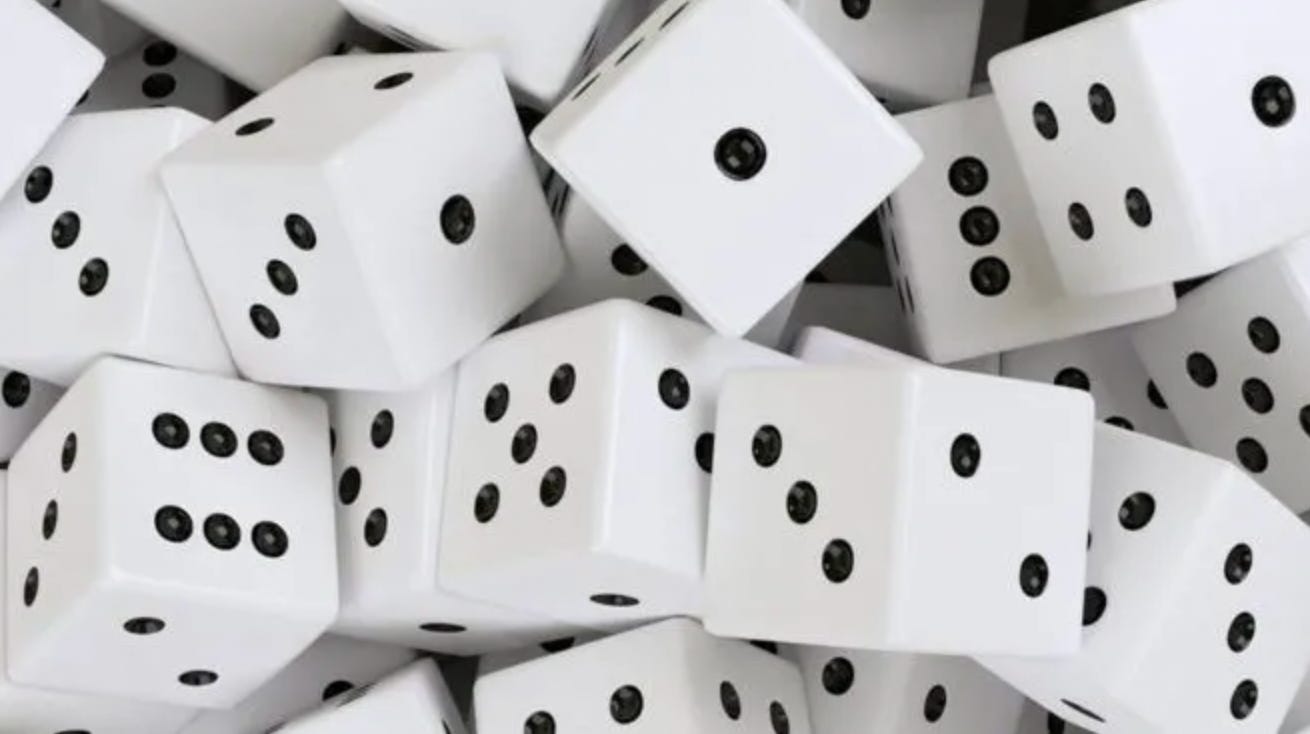
Hot slot? You’re just rolling the die; hitting a few in a row is statistically inevitable. Cold slot? Same thing—losing streaks are statistically inevitable.
Raised your stake hoping to “catch” the bonus? The RNG keeps generating numbers the same way. The die keeps rolling.
Haven’t seen a bonus for a long time, so it must be due soon? It might take just as long again. The probability stays the same. The die keeps rolling.
Just hit a bonus, so the next one won’t come for a while? Same story: the probability is the same. Zero can land 2, 3, 4 times in a row and more—it’s only a matter of time.
The RNG is generating numbers all the time. It doesn’t matter whether you press the button with your right or left hand, play day or night, drunk or sober, whether you’ve been winning or losing, whether it’s your first session or your last—none of that matters. The die keeps rolling continuously.
Can the system be trusted?
RNGs are heavily regulated and tested by independent labs: BMM Testlabs, iTech Labs, GLI, eCOGRA, and others. They run billions of test cycles, inspect the source code, and verify that the results are statistically fair.
But the Bernie Madoff story is a reminder: even in the most tightly regulated industry—finance—he managed to fool the SEC and national banks around the world for 19 years. Wherever there are people, there’s always room for mistakes…
The key takeaway
Your die has billions of faces. You roll it anew each time. Every roll is independent—no memory, no emotion, no awareness of your stake or history.
The RNG doesn’t adjust to the RTP. RTP is determined by the slot’s paytable and math model. If a die has six faces, you bet $1, and get $6 when you guess correctly, the RTP is 100%. If the payout is $5.70 instead, the RTP drops to 95%. But the die itself rolls exactly the same way.
In the short run, anything can happen. In the long run, the house edge always manifests—unless you’re playing with a genuine advantage. How long that “long run” is depends on variance and can differ by orders of magnitude.
Understanding how RNGs work clears away illusions and brings clarity. You stop searching for patterns that don’t exist. You stop chasing or doubling bets because you think a bonus “must” be due. You simply keep rolling the die.
The only difference is that sometimes you can find rare cases where the payout is higher than it should be—bonuses, cashback, tournaments, progressive jackpots, or other promos that add real value. That’s what I write about on my blog.
But even when you play with an edge—you’re still rolling the die. It’s just that now, the winning side pays 6.5 to 1 instead of 5.7 to 1.
“Here’s the key insight: when you hit “Spin,” the RNG doesn’t start—it stops. Your click freezes it at one specific point in time”
This was good.
Instead of using RNGs, HHR machines consult a database of horse racing results to determining the outcome of each spin. Also, the prize won (if any) is calculated by reference to the pari-mutuel payoffs of the selected races. Additionally, in most HHR jurisdictions the player must be given the option of manually handicapping ten races, albeit with some of the key statistics obscured from view. What is your opinion: is HHR random, or not?