

So we know the break-even point for a progressive jackpot slot. But before you put money into that jackpot, it is worth working out whether it can even reach that point before it drops. And if it can, how often that happens.
Does the jackpot ever hit break-even?
Grand Spinn survives to the break-even point in 6.6% of cases, roughly every 15th jackpot.
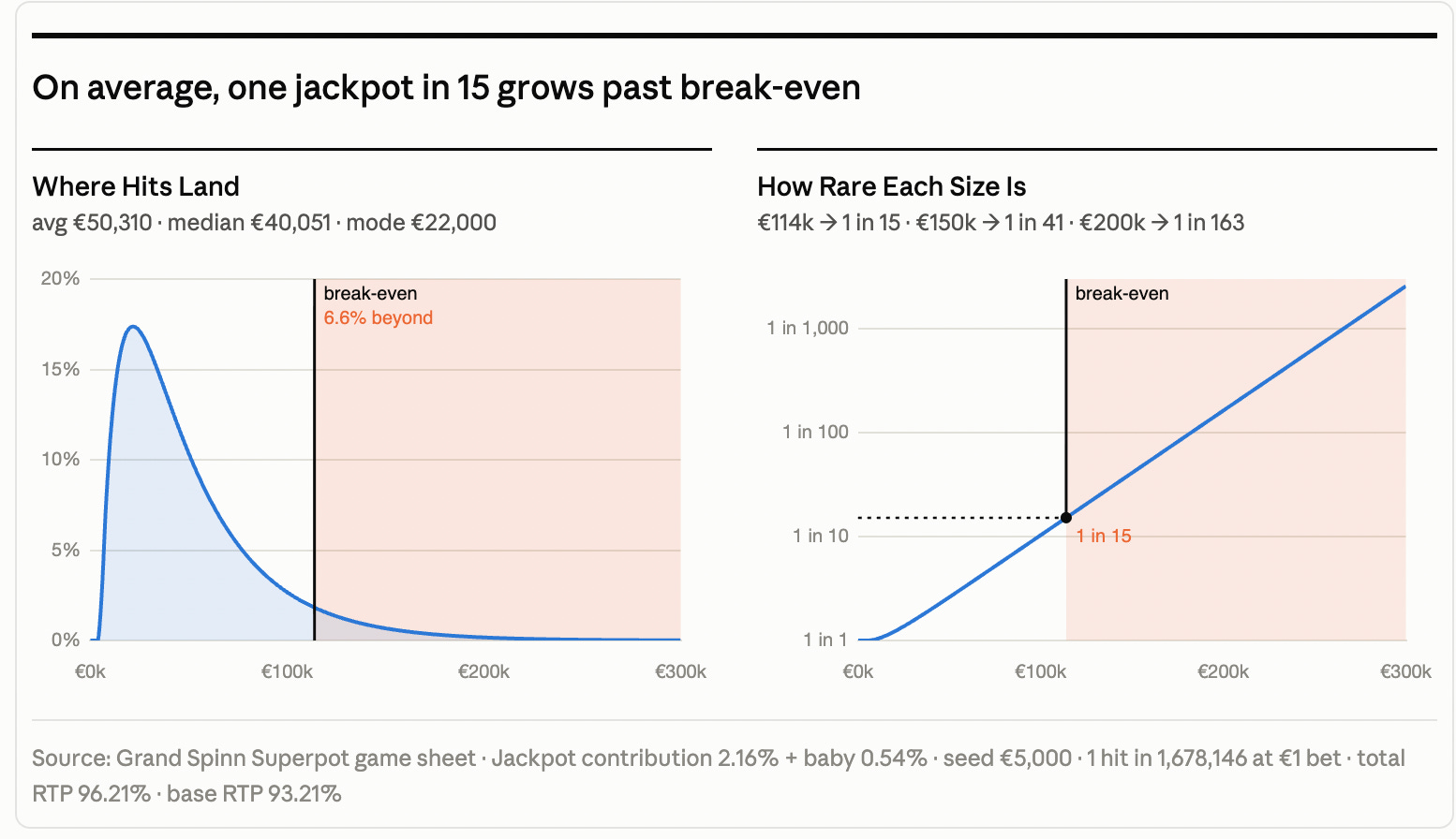
Why so rare? How often a jackpot reaches break-even depends on what share of each bet goes into the pot. The bigger the share, the more often it gets there. The smaller the share, the less often. Make it too small and it never gets there at all.
Where the contribution goes
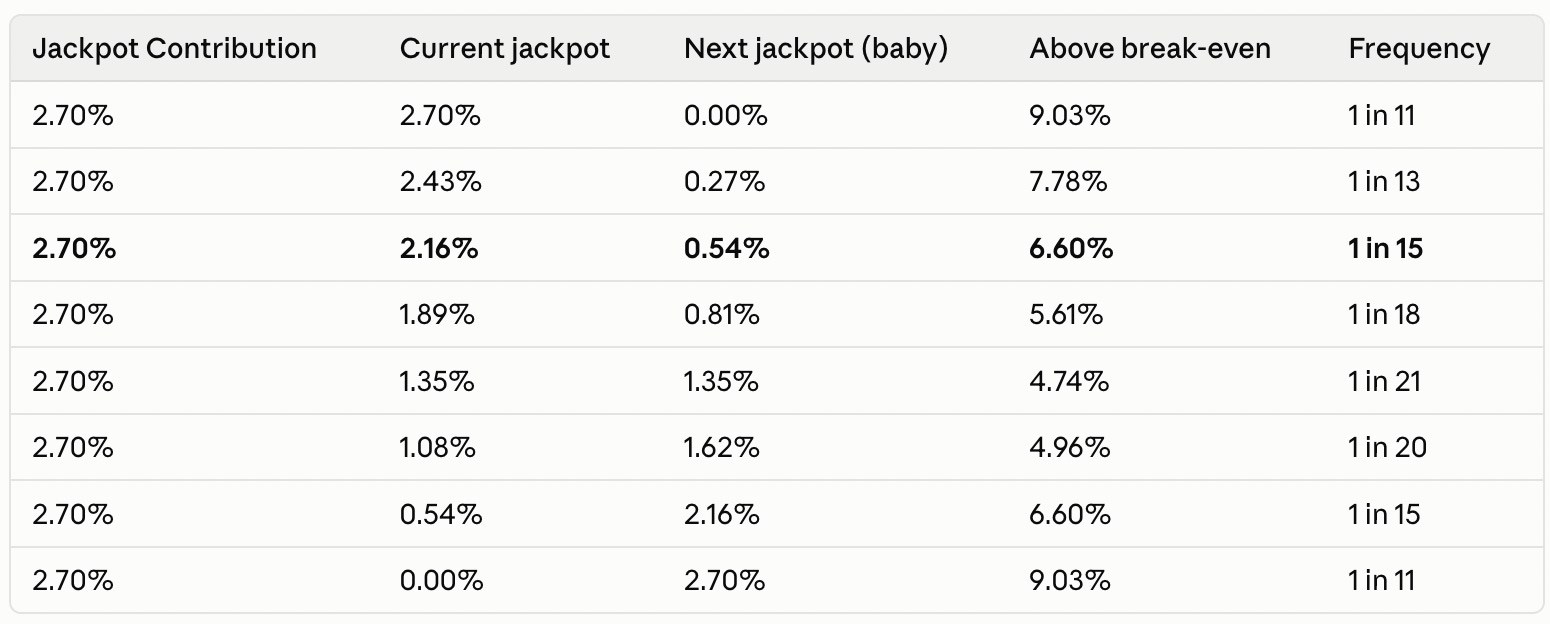
In Grand Spinn the 2.7% contribution is split between the current jackpot and the next one, 2.16% and 0.54%. That split affects how often the jackpot reaches break-even, like this.
For maximum EV you want the whole contribution to go into the current jackpot. First, more jackpots reach break-even. That makes sense, for the same amount of betting the pot grows by more. Second, it raises the EV of playing the jackpot, because everything your bets put in comes back to you along with the win. With a baby jackpot, part of your bets goes into the next pot, which may never reach break-even, and you may never get to play it.
One more interesting point. If the whole contribution went into the next jackpot, which I have never seen in practice and which makes zero sense from a marketing or excitement point of view, the jackpot would reach break-even just as often. But then it would be a true break-even point that always stays at the same level.
How big the contribution is
But even if 100% of the contribution goes into the current jackpot, the jackpot can still be a dead end if the contribution itself is small. In this case, if the contribution were 1%, the jackpot would reach break-even once in 120, even though the break-even point itself would drop from 114k to 85k1. And the EV of playing it would fall almost threefold.
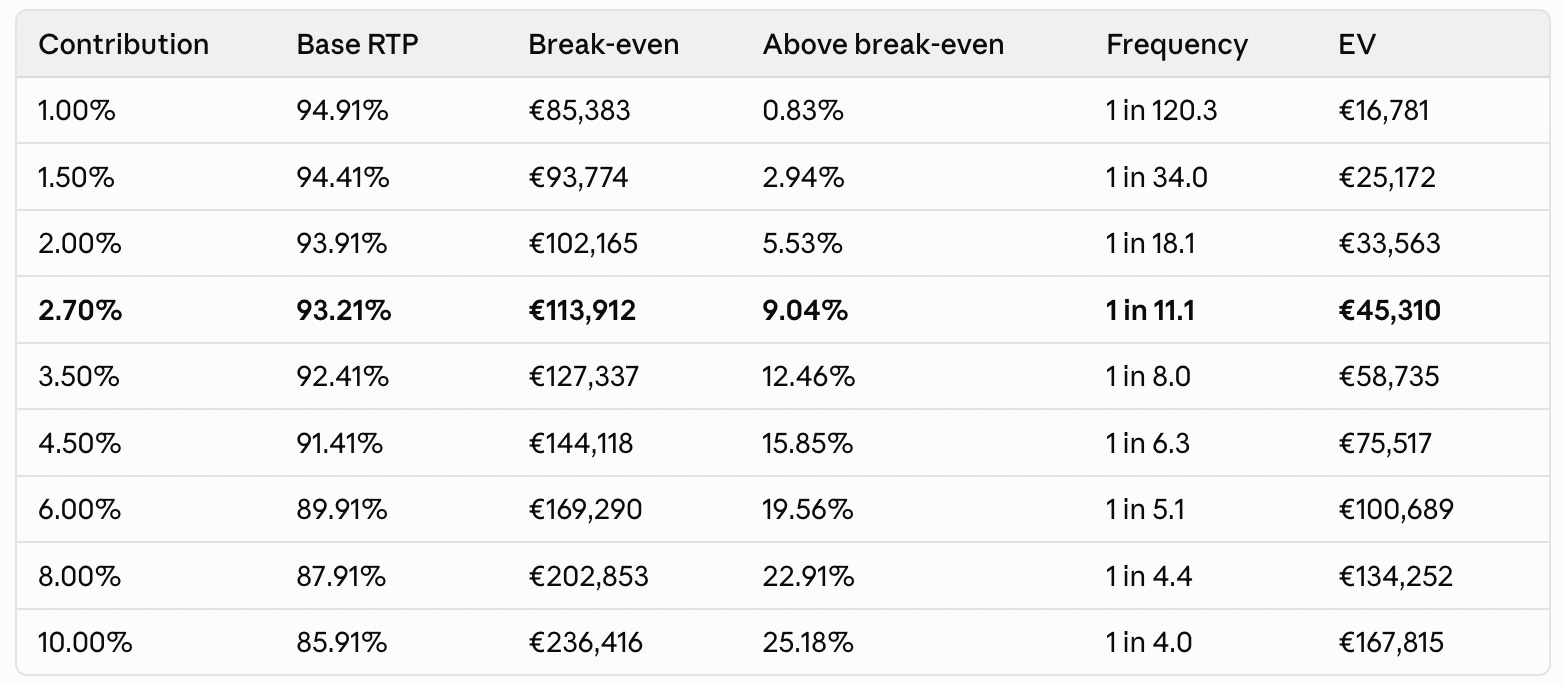
The other way round, at 10% every fourth jackpot would be positive, but the break-even point would fly up to 236k, and the EV would be at its maximum. Most players would be playing at 86% RTP, just so a jackpot hunter or a syndicate can turn up at the end and take the pot.
Nobody plays it, nobody wins it
And even if a slot has a high jackpot contribution, all of it going into the current pot, plus a high base RTP, the jackpot can still be worthless if nobody plays it!
So the game has to be popular. If nobody plays it, it does not matter how good the math is, it will never be +EV. Take Playtech’s jackpots. They used to be very popular, and now the patient is more dead than alive. Same with 888’s exclusive jackpots, which, judging by how slowly they grow, almost nobody plays. So you need at least a rough estimate of how many +EV jackpots you can expect in a year.
To be fair, Grand Spinn is not the best example, either in how often it hits 100% RTP or in how popular it is. Mega Joker, for example, is positive more often than every fourth time, its base RTP and jackpot contribution are higher, and more people play it.
I have played only 2 positive Grand Spinns, around fifty Divine Fortunes and more than one hundred Mega Jokers. And Red Tiger's network jackpots drop even more often than that. Each of these deserves its own post. I deliberately did not start with the most popular one.