

A while back, in the post about why progressive jackpot slots beat regular slots, I said I would explain how the RTP calculation on these games actually works in a separate post.
This is that post. Full method, then a real slot worked end to end.
Why timing is the whole game
In most casino games nothing carries over. Whatever happened before you got there does not matter, and whatever you do will not matter to whoever sits down after you.
In some games it works differently. Their state changes over time, and the return to the player goes up or down. Sit down at a bad moment and you are playing below the advertised RTP. Sit down at a good one and you can be over 100.
These are games with persistent state.
Blackjack is the classic example. Every card that leaves the deck changes the state of the deck, and each rank moves it by a different amount. Strip every five out of the deck and players will line up around the block. Strip every ace and the line disappears.

Accumulator slots work the same way. Playing Buffalo Link when one buffalo remains out of 1,600 to trigger the bonus is a completely different game from playing when you still need a thousand. Buffalo Ascension does it with the reels. Playing it when they have grown all the way up is a completely different game from playing it when they are at the minimum.
Progressive jackpots follow the same logic. Playing when the pot has reached half a million is a completely different game from playing when it sits at 20,000. You can be playing with 93% RTP or 103% RTP — the difference is massive.
There's one more game where RTP can swing from 50% all the way to 150% and higher. I'm not laying all my cards on the table right now though — that's a story for several separate posts.
To get a real edge in progressive jackpots, you need four things:
Find the break-even point, the jackpot value at which the house edge goes to zero.
Only play above that point.
Have a bankroll big enough to keep risk of ruin low.
Play systematically and put through as much volume as you can.
Finding the break-even point
You need four numbers: how often the jackpot drops, how much of each bet feeds the pot, the RTP of the base game with the jackpot stripped out, and the seed value.
Jackpot frequency is the hard one, and it is the one you cannot work around. Three ways to get it.
1. Read the provider’s documentation. Some studios publish it. NetEnt and Yggdrasil, for example. It is rarely sitting in plain sight, but it can be found.
Easiest route when it works. In a fair world every provider would publish its jackpot mechanics for the sake of transparency. In the real world that same information hands advantage players an edge, though I doubt the studios lose much sleep over that particular consequence. They hide everything by default.

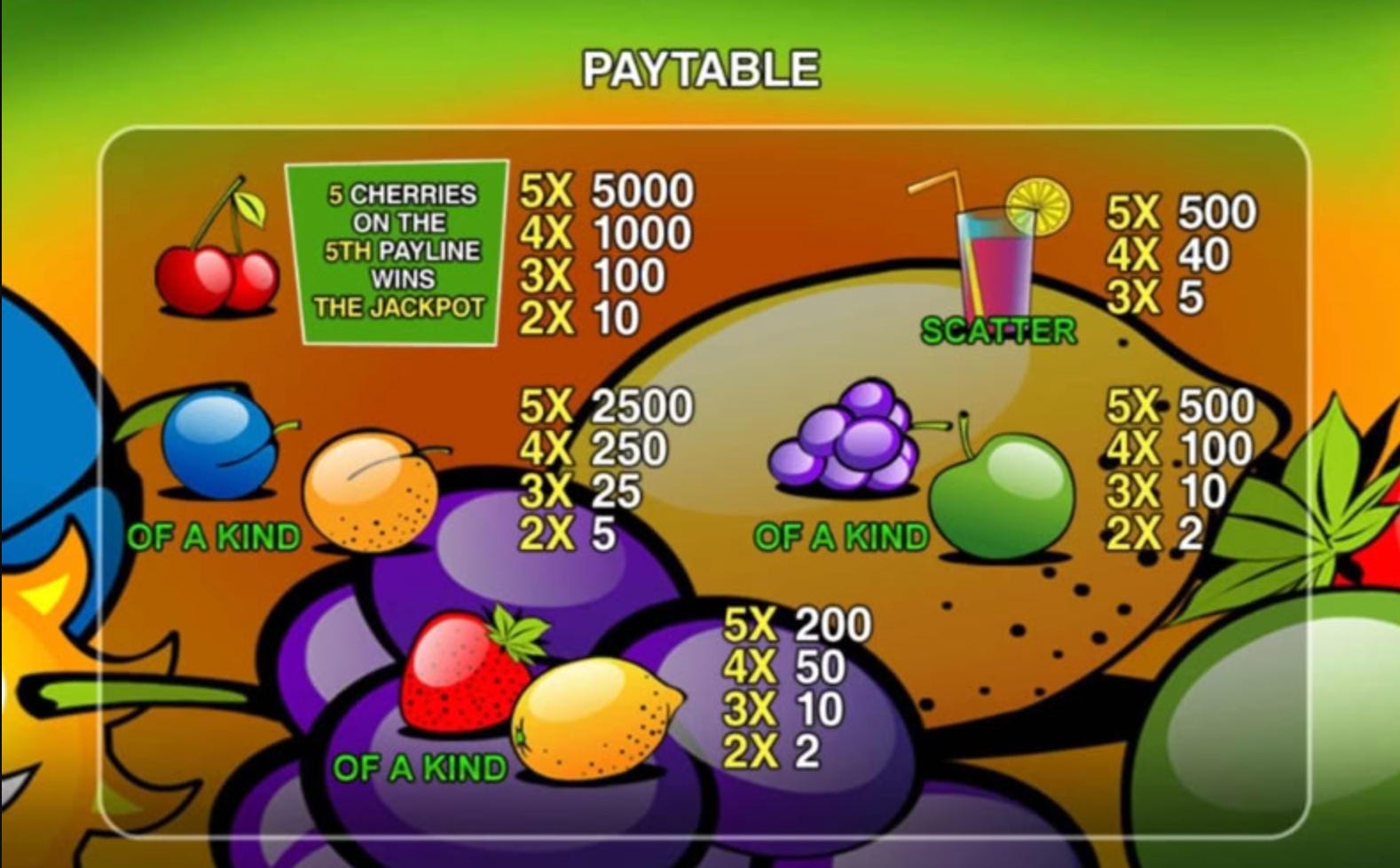
2. Work it out yourself. A bit harder, and it only works when the jackpot is tied to one specific, definable event. A royal flush in Caribbean Stud, five identical numbers in a row on roulette, five cherries on line 5, ten winning spins back to back, and so on.

Caribbean Stud is easy once you have the paytable. It's not that hard to calculate in Google Sheets1, especially these days with LLMs becoming so common. I spotted a +EV situation in Caribbean Stud twice. The first time I didn't have the bankroll for it. The second time I didn't have the opportunity.
Roulette is easier still, everyone knows the hit rate of a single number, you just multiply the probabilities. Slots take more work. You need a few hundred spins to estimate hit frequency, or the frequency of a cherry on line five, and at that point you may as well go back to option one and hunt for the documentation.
3. Collect data on real jackpot drops.
Slowest and most painful. You log drops until the average settles down, then work backwards to frequency.
The problem is how slowly it settles. With 95% confidence, and assuming drops are memoryless, the error on your average runs at roughly two divided by the square root of your sample. Which sounds abstract until you convert it into the number you actually care about.
Break-even scales one to one with frequency, so the error carries straight through. Say your calculation lands on a break-even of €100,000. Here is how much you can trust that number:
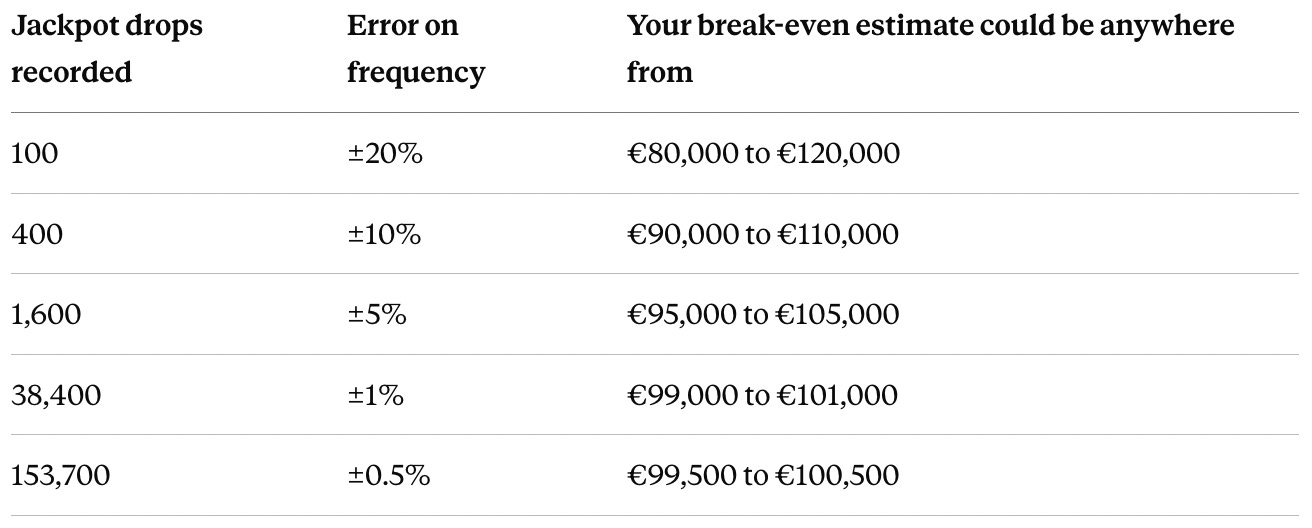
At 100 drops your entry point has a €40,000 window in it. You either start way too early and burn money, or way too late and hand the spots to competitors.
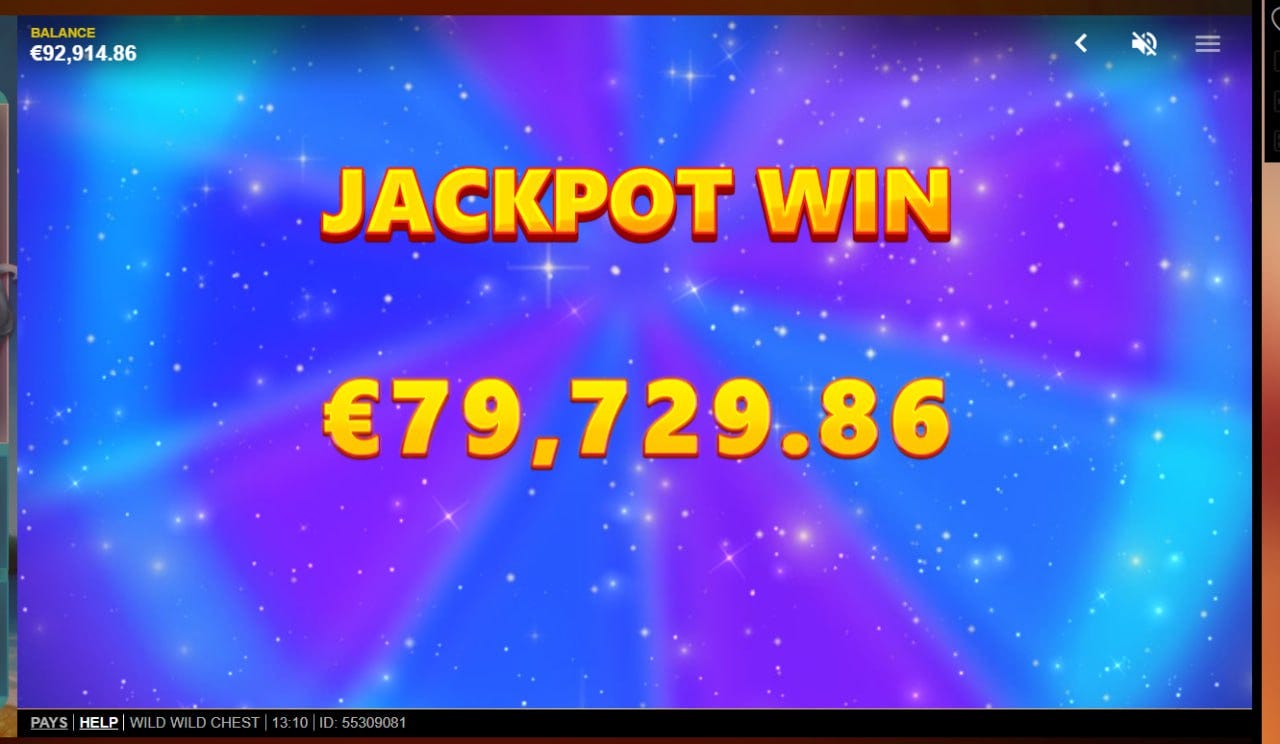
This only works for jackpots that drop several times a day. Usually that means global pots like Red Tiger, where one jackpot is shared across a large group of casinos. Or a local pot at a very large casino, like the one in Michigan that got farmed for a long stretch by players who read this blog. I wish I could write that. They worked it out on their own. Still, the example holds up. You gather the data, you calculate the break-even point, you get your edge, and then you get your account closed, exactly like they did.

So, most progressives have a jackpot value above which their RTP passes 100.
To find it you need the jackpot frequency, or the average value the pot drops at, which gives you the same thing.
Break-even = (1 − base RTP) × turnover per jackpot
Now to the real examples, and to why the best moment to sit down is not always the break-even point.