

RTP — or Return to Player — is one of the most important metrics in gambling. It’s essentially a built-in commission that you pay for the privilege of playing. When you bet $100, part of that wager goes to the casino and the rest theoretically returns to players over time.
RTP + House Edge = 100%
This doesn’t happen with every spin, but as a mathematical expectation — in theory. When people talk about RTP, they mean theoretical RTP measured over a very large number of plays. How long that “long run” needs to be depends on volatility, and it varies from one game to another.
You can bet $100 on red and lose — your actual RTP is 0%, and the house edge is 100%. Or you can win and double your money — that’s 200% RTP and 0% house edge. These are examples of actual RTP, but over time the casino will always take its share. Eventually, the actual RTP converges with the theoretical one.
How it works
Take a simple example: flipping a fair coin. There are two possible outcomes — heads or tails — with a 50% chance, or 1 in 2.
If you bet $200 and the payout for guessing correctly is $400 (a 2x return), RTP is 100%. Nobody loses. The odds are 1 in 2, and the payout is 1 in 2.
If the payout is reduced to $360, RTP becomes 80%. The odds are still 1 in 2, but now the payout is 1 in 1.8 — the casino keeps 20% as a commission.
That’s how RTP is formed: by paying out probabilities at a slightly worse rate than their true odds.
Bookmakers work the same way. A penalty shootout between equally matched teams might be priced at 1.8 instead of the fair 2.0. The difference is the bookmaker’s margin.
Now flip it around — if you get paid $440 instead of $400, RTP becomes 120%. Would you take that bet?
It’s a 50/50 shot: you either lose $200 or win $440. The expected value is positive — you’re making money in the long run. Yet, as Daniel Kahneman’s research and countless YouTube experiments show, most people decline such bets. The fear of losing $200 outweighs the desire to win $240.
Advantage players don’t decline. They look for these opportunities and take them again and again. Over time, the math wins — and so do they.
How a slot works
Modern online slots operate exactly the same way, except instead of a coin you have reels, and instead of two outcomes you have thousands of combinations. The core principle remains: the casino pays out probabilities at worse odds than they truly are — and that gap is your RTP loss.
There are reels with a fixed order of symbols. A random number generator (RNG) determines where each reel stops. There’s a payline structure, a paytable, and additional rules such as multipliers or bonus rounds. I’ve explained RNGs and randomness in another post.
Example: The Dog House
In the slot The Dog House there are 5 reels for the base game and 5 reels for the bonus game.
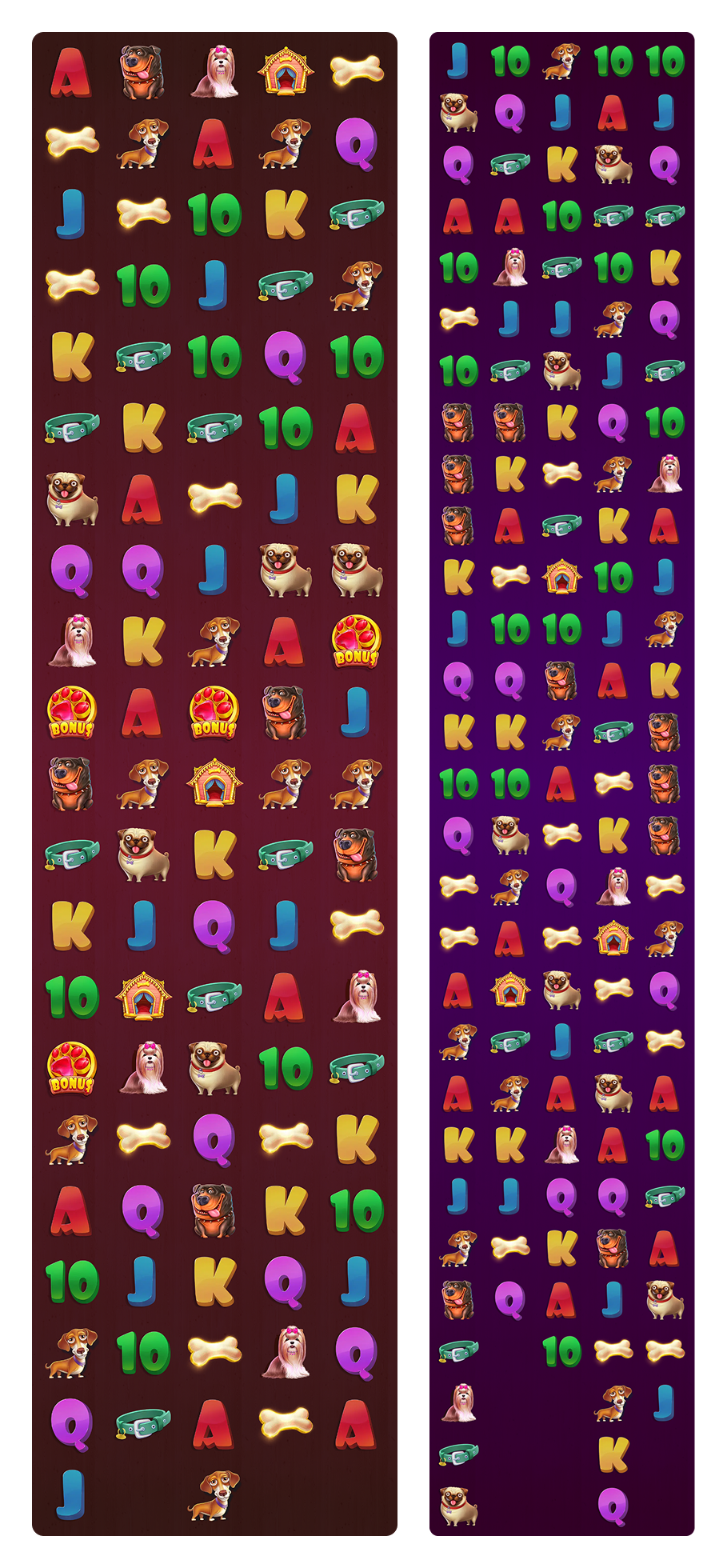
Here’s what it looks like in the code:
Base reels:
Reel 1: 9, 8, 12, 8, 10, 7, 5, 11, 4, 1, 3, 7, 10, 13, 1, 6, 9, 13, 6, 11, 12
Reel 2: 3, 6, 8, 13, 7, 10, 9, 11, 10, 9, 6, 5, 12, 2, 4, 8, 11, 12, 13, 7
Reel 3: 4, 9, 13, 12, 13, 7, 8, 12, 6, 1, 2, 10, 11, 7, 5, 11, 3, 10, 8, 9, 6
Reel 4: 2, 6, 10, 7, 11, 13, 12, 5, 9, 3, 6, 7, 12, 9, 13, 8, 10, 11, 4, 8
Reel 5: 8, 11, 7, 6, 13, 9, 10, 5, 1, 12, 6, 3, 8, 4, 7, 10, 13, 12, 11, 9
Bonus reels:
Reel 1: 12, 5, 11, 9, 13, 8, 13, 3, 3, 3, 10, 12, 11, 10, 13, 11, 8, 8, 9, 6, 9, 10, 12, 6, 3, 7, 4, 7, 5
Reel 2: 13, 11, 7, 9, 4, 12, 7, 3, 10, 9, 8, 13, 11, 10, 13, 5, 6, 9, 2, 7, 6, 10, 12, 8, 11
Reel 3: 6, 12, 10, 13, 7, 12, 5, 10, 8, 7, 2, 13, 3, 6, 9, 8, 11, 8, 5, 12, 9, 4, 11, 10, 9, 13
Reel 4: 13, 9, 5, 7, 13, 6, 12, 11, 6, 10, 13, 12, 9, 7, 8, 10, 4, 2, 8, 7, 5, 9, 11, 3, 12, 8, 6, 10, 11
Reel 5: 13, 12, 11, 7, 10, 11, 7, 13, 4, 9, 12, 6, 10, 3, 3, 3, 8, 6, 11, 8, 9, 13, 7, 9, 5, 8, 12
And here’s what it looks like on the screen.
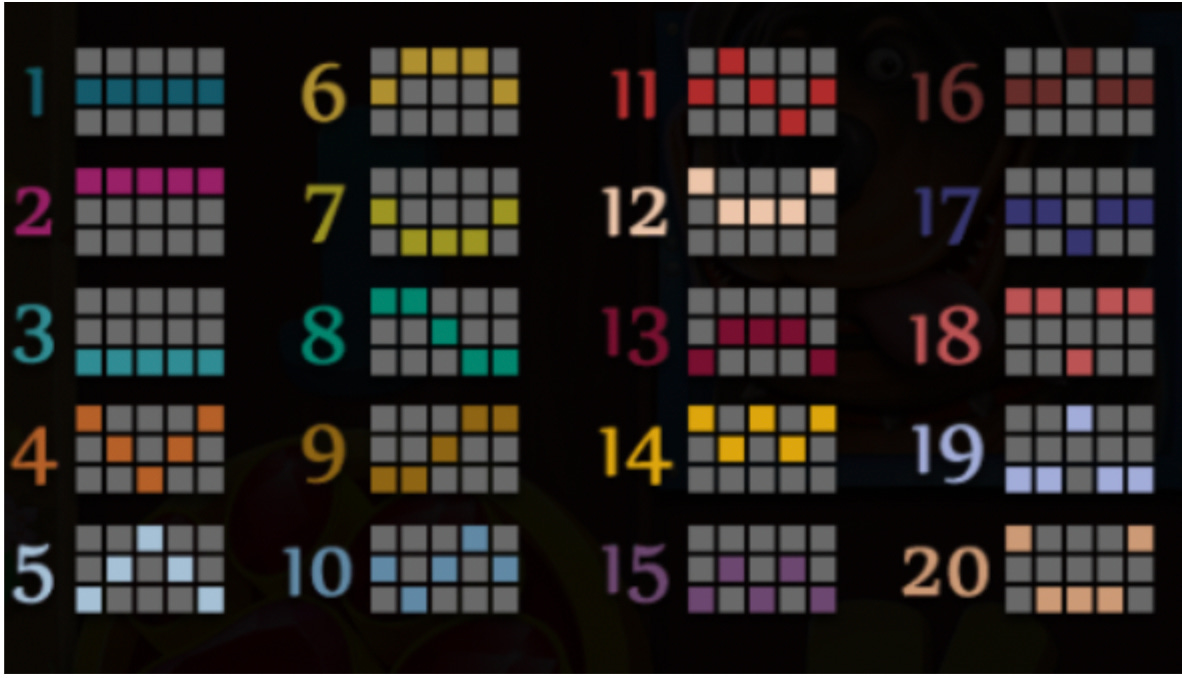
There are 20 paylines.
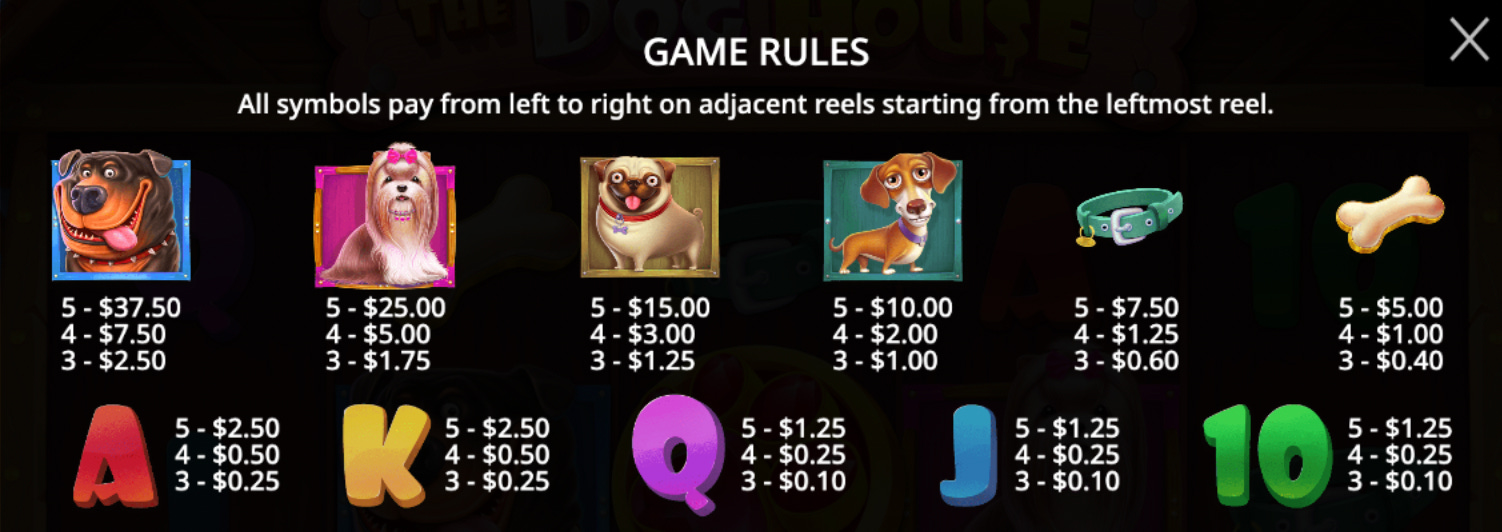
There are defined paytable — for example, five Aces on one line pay 2.5× your bet.
There are also rules. A Wild can randomly take a multiplier of x2 or x3 . Three Bonus symbols trigger Free Spins, where the game uses a separate set of reels and sticky Wilds. The number of spins is random but follows a known probability distribution.
Add all this up — paylines, payout table, extra features, reel order and the random number generator that determines each reel’s position, and the result is a calculated RTP of 96.51%.
Chance of hitting the max win
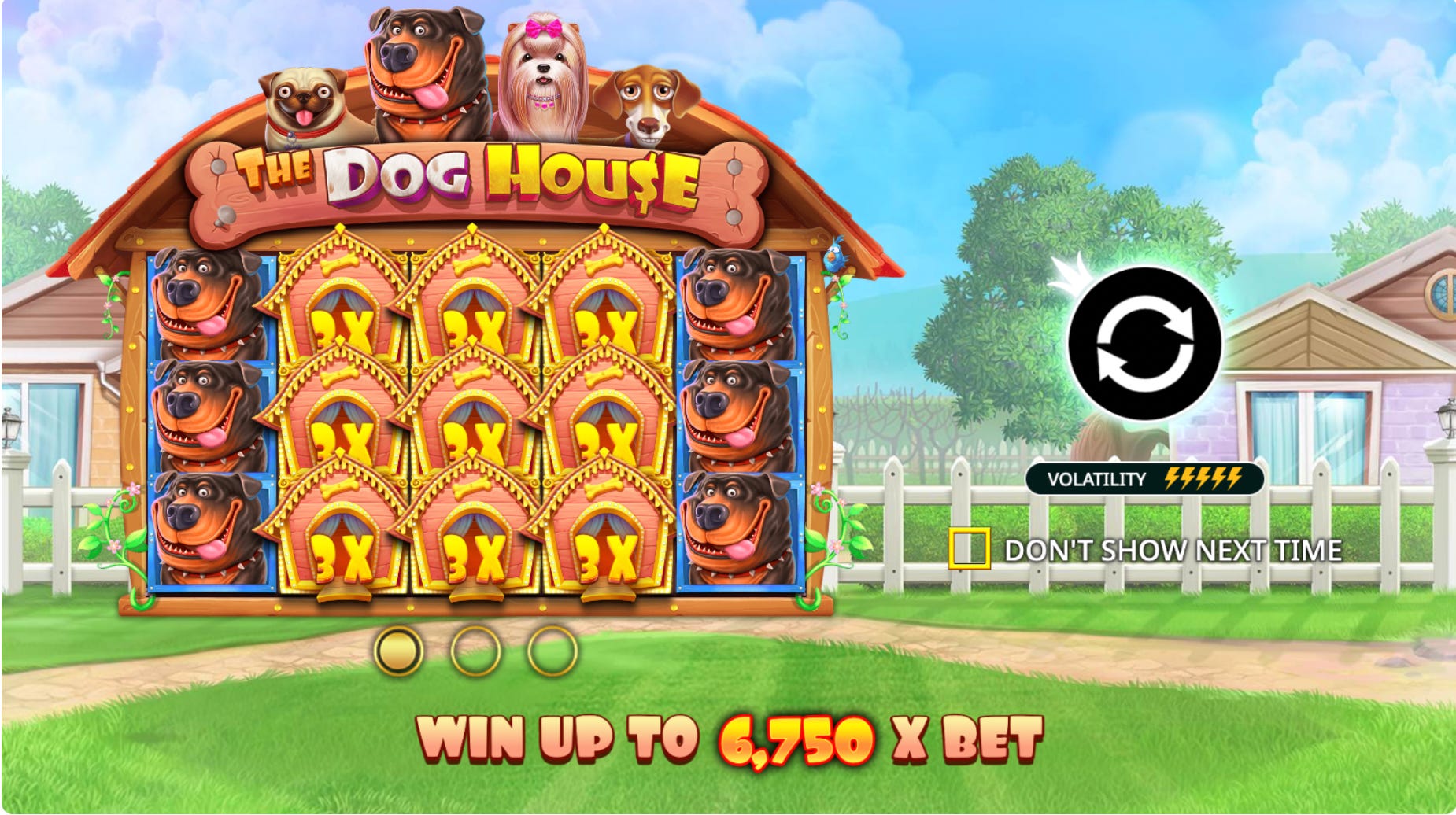
The maximum win — usually shown in the game preview — requires an extremely specific combination:
Three Bonus symbols on reels 1, 3, and 5
Nine Wilds with x3 multipliers during the bonus round (only one Wild per reel)
Every Wild must be x3 (40% probability, based on a 50,000-Wild sample)
Plus, three Rottweiler symbols on reels 1 and 5 simultaneously
Combined, that’s about a 1-in-8.3-billion shot (based on the provider’s documentation).
Two main slot models
There are two fundamental ways slots determine outcomes: Reels First and Prize First.
In the Reels First model, the game randomly selects which symbols appear on each reel. The resulting combination determines the payout. Probabilities are based on the cumulative frequency of all symbols — scatters, wilds, bonuses, and so on.
Key points:
The number of symbols per reel can vary.
There can be multiple reel sets — e.g., Hotline uses three reel variants in the base game and four in the bonus.
The sequence of symbols might not be fixed.
Symbol odds don’t have to be equal.
In the Prize First model, the game first determines the payout amount based on preset probabilities, then generates a reel animation that visually matches that outcome.
This approach is used by developers like Push Gaming, and also appears in some NetEnt and Yggdrasil titles such as Jack and the Beanstalk or Vikings Go to Hell.
Think of it like this:
In Reels First, you flip a coin and see the result when it lands.
In Prize First, the system already knows it’s heads — you just watch a beautiful animation of the coin spinning and landing on heads.
For the player, there’s no difference. The probability stays the same — only the execution differs.
Different RTP versions
Most slots exist in multiple RTP configurations — 92%, 94%, 96%, and so on. Casinos choose which version to run. To lower RTP, developers can tweak reels (fewer high symbols, more low symbols) or adjust paytable probabilities.
For example, in Sakura Fortune you can find several versions of the same slot — from 87% to 96% RTP. The lower the RTP, the less the base game pays and the fewer frequent hits you’ll see, while the bonus round stays identical.
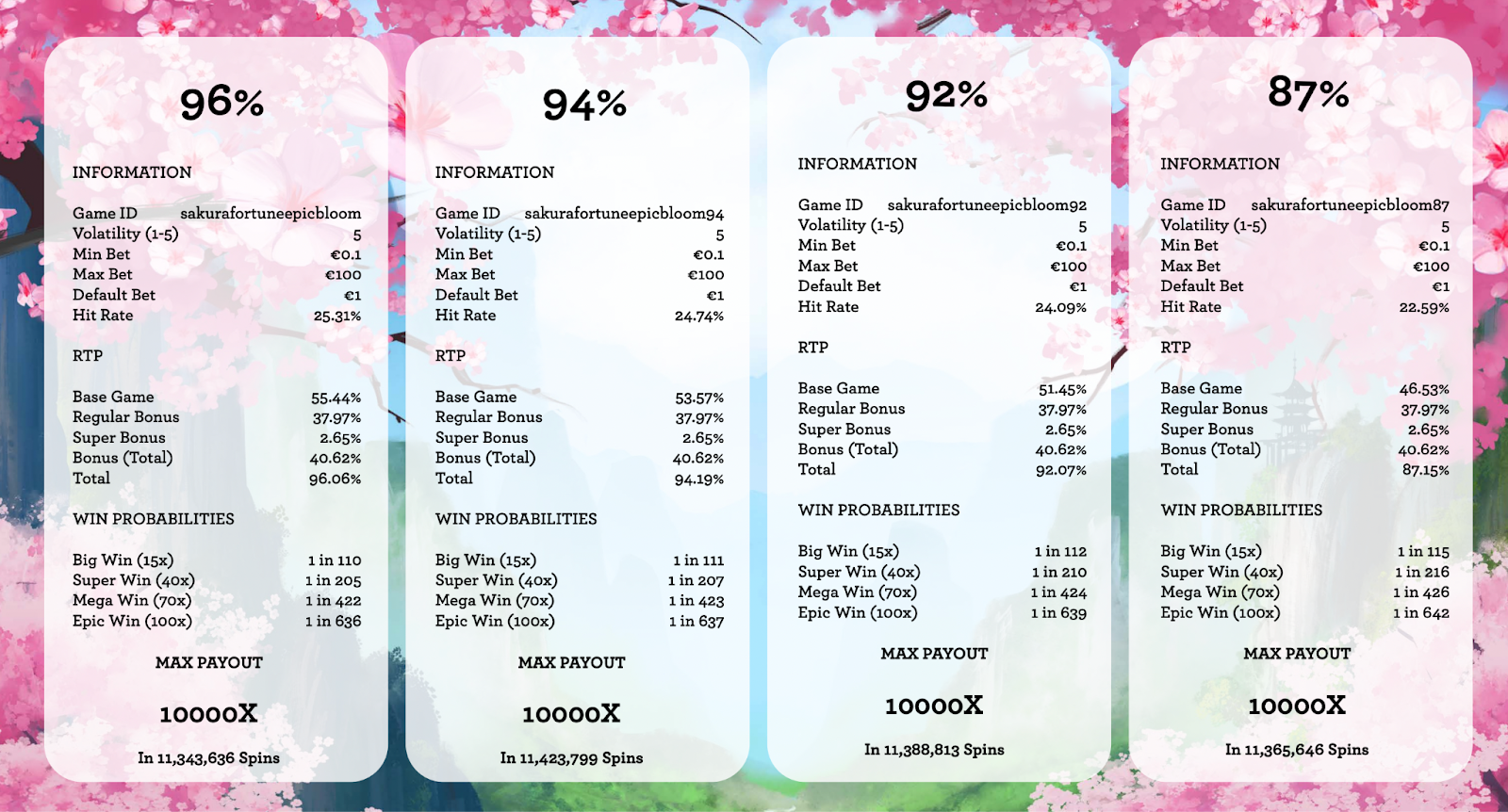
You can often check the RTP in the game’s “info” or “paytable” menu — but some providers, like Play’n GO, hide it. In their case, you can only find it through server responses.
Bugs in slots
Slots are built by humans, and sometimes post-release versions don’t behave exactly as intended — especially in games with accumulators.
In Microgaming’s Batman vs Bane, the initial release didn’t apply average weighted bet logic for bonus triggers, allowing players to build progress at low stakes and then cash out at higher ones.
NetEnt’s Street Fighter had a design flaw where betting patterns affected gameplay outcomes.
In Playtech’s Fire Blaze Red Wizard, a bug once caused several hours of consecutive winning spins.
Long-term RTP
For long-term play, higher RTP is always better. A 96% RTP versus 94% may not sound like much, but the difference in house edge (4% vs 6%) is a 50% increase in expected loss. The lower the volatility, the faster this difference compounds.
Compared to live games, slots usually have a much worse house edge — often ten times higher. Blackjack can have an edge of 0.5%, while many slots sit around 5%.
However, there are exceptions: Book of Dead has 99% RTP, and Mega Joker can reach or even exceed 100% depending on the jackpot level — just like some progressive jackpots that briefly turn positive when the prize pool gets large enough. The first case is about knowing the right slots; the second is about understanding the math — and reading my blog.
Bonus buys accelerate convergence to theoretical RTP because they skip variance and force higher bets, increasing both expected loss and bankroll turnover.
Conclusion
RTP applies to wagered volume, not deposits. The more spins you make and the lower the volatility, the faster your actual RTP aligns with the theoretical value.
RTP is simply the rulebook for how probabilities are paid. Like RNG, it doesn’t care whether you’re winning or losing. In fair roulette, one zero means a 2.7% commission per spin; with two zeros, it’s 5.4%.
But this can change with bonuses, cashback, comp points, tournaments, or other rewards — you can read about a real case of 106% RTP in roulette.
In short: play higher-RTP games, play longer, and if you’re a streamer — go for higher volatility too.